
Key Takeaways
- A branded auto repair estimate template in PDF format signals professionalism that handwritten quotes cannot match, reducing walkouts and building customer trust before any wrench is turned.
- Legally defensible estimates require specific fields including VIN, authorization language, warranty terms, and estimate validity periods. California law mandates customer authorization before any repair work begins.
- Most free templates lack critical legal and commercial fields. Shops should audit every template against a compliance checklist and have local counsel review final wording before full rollout.
Table of Contents
- Why a professional estimate (not a torn scrap of paper) pays off
- Must-have fields for a legally defensible estimate (checklist every shop needs)
- State compliance and legal risk — what to watch for (start with California)
- What free PDF templates commonly miss (legal & commercial gaps)
- Design and content elements that reduce walkouts and disputes
- How to convert your triplicate/paper workflow to a branded PDF (step by step)
- Sample downloadable estimate and edit checklist (what to change before you use it)
- Compliance pitfalls and how estimates can trigger enforcement
- Quick conversion playbook + KPIs to measure success
- FAQ and legal disclaimer (what to tell customers and your lawyer)
Why a professional estimate (not a torn scrap of paper) pays off
Every auto repair shop owner who still reaches for a handwritten triplicate pad needs to hear this: your auto repair estimate template is a sales tool, not just paperwork. When a customer sees a clean, branded PDF with their name, vehicle details, and a clear parts and labor breakdown, something shifts in their mind. They stop wondering if they are at the right shop and start seeing you as the professional who will fix their car correctly.
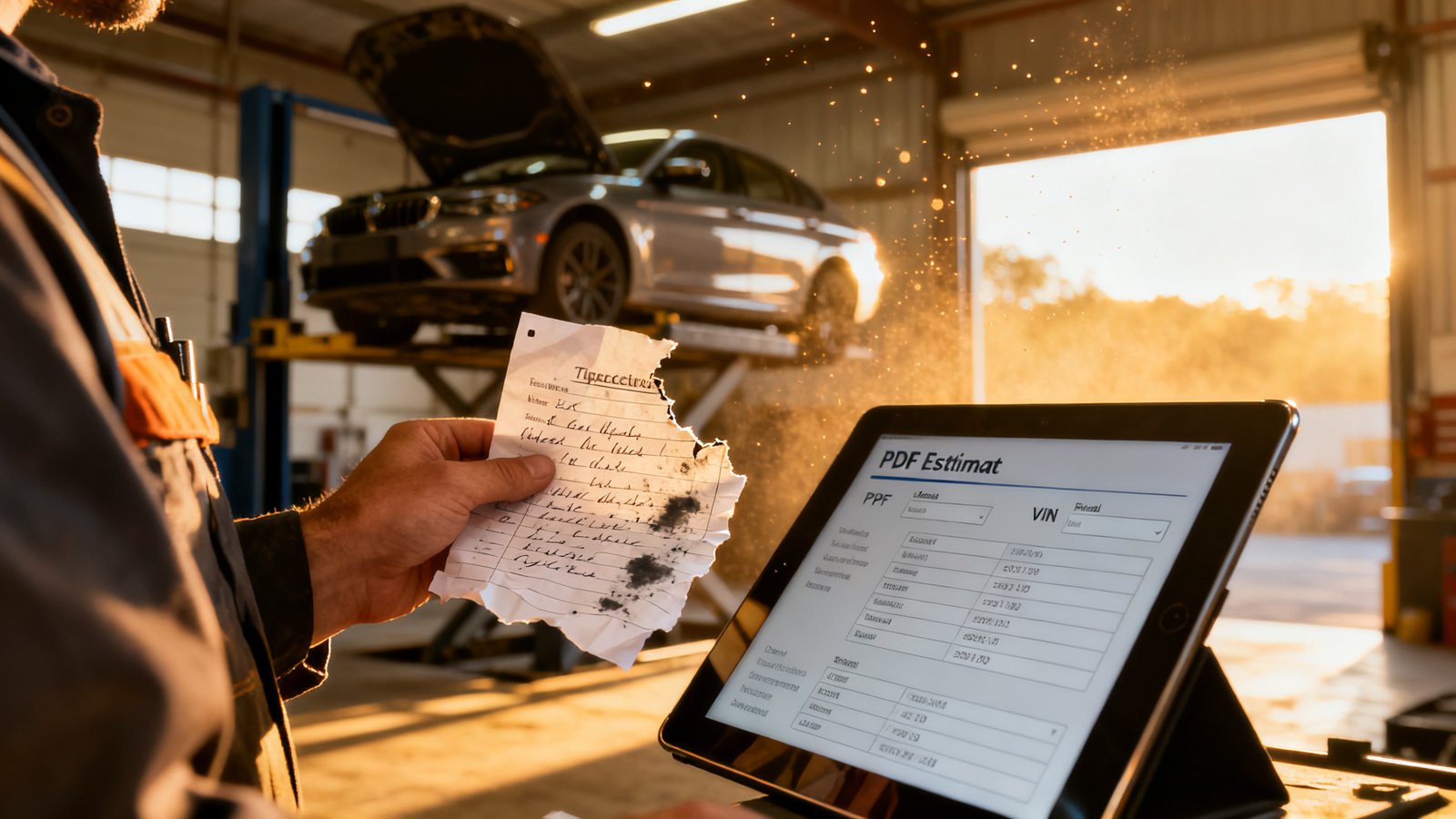
Handwritten estimates carry baggage. They look rushed, approximate, and negotiable. Customers read sloppy handwriting and instinctively question whether the numbers were made up on the spot. A typed, itemized estimate printed on your shop letterhead or sent as a branded PDF does the opposite. It communicates that your pricing is calculated, your process is transparent, and your shop operates with precision.
Industry commentary confirms this shift. As one source observes, “the days of handwriting estimates on a legal pad and mailing them are over” and “your competitors are sending professional, branded documents.” (source) The implication is clear. Customers who receive a polished estimate are more likely to approve the work without haggling or walking across the street for a second opinion.
Disputes also drop when estimates are clear. A handwritten line that says “fix brakes” leaves enormous room for disagreement later. A detailed estimate that specifies brake pads, rotors, labor hours, and warranty coverage leaves almost none. This protection works both ways. Your customer knows exactly what they are paying for, and you have documentation that shows exactly what was quoted and authorized.
For shops looking to upgrade their quoting process across multiple service categories, the approach parallels what other trades already use. Whether it is a free roofing estimate template for storm damage jobs or a free HVAC estimate template for system replacements, the principle is identical: professional presentation closes more jobs.
Must-have fields for a legally defensible estimate (checklist every shop needs)
A legally defensible estimate is not about fine print trickery. It is about documenting exactly what was discussed, quoted, and authorized before a single bolt is loosened. When disputes escalate to chargebacks, BAR complaints, or small claims court, the shop with complete documentation wins. The shop with a notepad scribble loses.
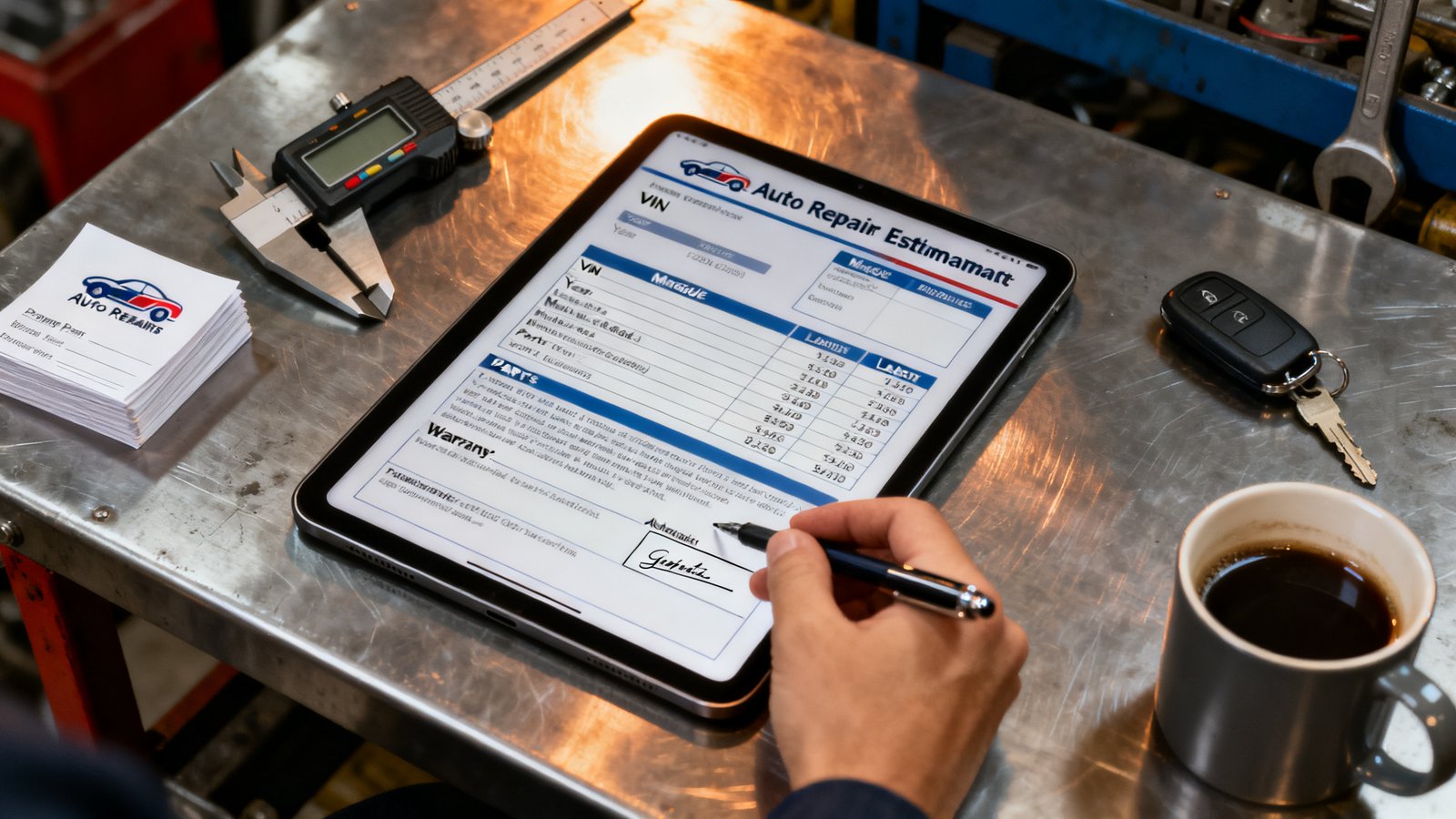
Here is the minimum field set every mechanic estimate form or vehicle repair estimate should include, along with why each matters:
| Field | Why It Protects Your Shop |
|---|---|
| VIN (full 17 characters) | Ties the estimate to one specific vehicle. Prevents confusion when a customer owns multiple cars or when part fitment questions arise. |
| Year, Make, Model, Engine | Essential for accurate parts sourcing. A 2018 F-150 and a 2021 F-150 may use different components. Document this upfront. |
| Current Mileage (Odometer Reading) | Establishes a timestamp for warranty claims and helps verify whether a follow up issue falls within the warranty period or mileage limit. |
| Customer Contact Information | Phone and email are non-negotiable. You need them for authorization calls, updates, and sending the final invoice. |
| Itemized Parts List with Prices | Transparency on parts costs prevents accusations of hidden markups. List each part number and retail price separately. |
| Itemized Labor with Hours and Rate | Shows exactly how labor cost was calculated. Disputes over “too expensive” shrink when customers see the hourly rate and book time clearly stated. |
| Taxes, Shop Supplies, and Discounts | Separate these line items. Bundling them into a lump sum invites questions and erodes trust. |
| Warranty Terms (Parts and Labor) | State exactly what is covered, for how long, and under what conditions. Ambiguity here is a leading cause of post-repair disputes. |
| Estimate Validity Period | Parts prices and shop schedules change. A 30-day validity window prevents a customer from returning months later demanding the same price. |
| Authorization Line with Signature and Date | This is the single most important field on the entire document. Without a signed authorization, you have no legal protection if the customer refuses to pay. |
| Shop License Number and Contact Info | Required by many state regulations. Shows legitimacy and gives customers a clear path for follow up questions. |
| Technician Notes or Diagnosis Summary | Documents the “why” behind the recommended repair. Supports the estimate if questioned later and helps the technician remember context when the job begins. |
State compliance and legal risk — what to watch for (start with California)
Every shop owner should understand one non-negotiable rule: in California, you cannot start repairs without first providing an estimate and obtaining customer authorization. This is not a suggestion. It is codified in the Business and Professions Code (BPC § 9884.9) and the California Code of Regulations (CCR § 3353.1). (source)
The authorization can be written, oral, or electronic. But here is the critical detail most shops miss: the method of authorization must be documented on the estimate itself before work begins. A verbal “go ahead” over the phone that nobody writes down is not compliance. It is a liability waiting to surface during a BAR audit or payment dispute.
What does this mean for your vehicle repair estimate or auto repair work order template? Every estimate you generate needs a clear, timestamped record of how and when the customer approved the work. If they approved by phone, note the date, time, and a brief summary of the conversation directly on the estimate. If they signed digitally, retain that electronic record. If they signed in person, keep the signed copy.
California is the only state with an explicit pre-repair estimate and authorization requirement identified in the available research. No other states were addressed in the supplied sources. This does not mean other states lack rules. It means shop owners outside California must proactively check their own state and local regulations. Do not assume your state is lenient just because it did not appear in a research summary.
A practical workflow for documenting authorization looks like this:
- Generate the estimate in your shop management system or using a professional estimate template.
- Present the estimate to the customer in person, by phone, or electronically.
- Record the authorization method immediately. If oral, write “Oral authorization received from [customer name] on [date] at [time]” on the estimate and initial it.
- If electronic, retain the email, text, or e-signature record with a timestamp.
- File the documented estimate where it can be retrieved quickly if a regulator or attorney requests it.
Retention matters. California BAR can request records going back several years. A missing estimate file from a job done 18 months ago can become a license issue today.
What free PDF templates commonly miss (legal & commercial gaps)
The internet is full of free downloads labeled as a car repair quote template PDF or a free mechanic estimate. Many of them look clean and professional at first glance. The problem is not the design. The problem is what they silently omit.
No evidence is available in the supplied research about exactly which legal fields free PDF templates drop. This absence of data is itself telling. When you cannot verify what a template includes or excludes against a known standard, you are gambling with your shop’s compliance. Treat every free template with skepticism and audit it against the checklist provided earlier in this article.
Common gaps we observe in practice include:
- Missing authorization language. A free template may have a signature line but no text explaining what the customer is authorizing. This ambiguity weakens your legal position.
- No warranty detail section. Vague warranty statements like “parts guaranteed” leave room for interpretation battles. A proper template spells out parts warranty, labor warranty, exclusions, and mileage or time limits.
- Absent labor rate disclosure. Customers have a right to know your hourly rate. Templates that only show a bundled labor total obscure this and can trigger complaints.
- No parts sourcing disclosure. Are you using OEM, aftermarket, or remanufactured parts? Some states require this disclosure. Free templates rarely include it.
- Missing estimate validity language. Without an expiration date on the quote, a customer could theoretically hold you to a price quoted six months ago when parts costs have risen significantly.
- No shop license or registration field. In regulated states, your license number must appear on estimate and invoice documents. Generic templates often skip this entirely.
The audit checklist is straightforward. Open any template you are considering and check for every field listed in the table above. If the template is missing three or more critical fields, it will cost you more in risk than it saves you in convenience. A handyman estimate template free download might work for small odd jobs, but auto repair carries regulatory weight that demands more rigor.
Design and content elements that reduce walkouts and disputes
How your auto shop quote template or auto repair estimate template looks on the page directly influences whether a customer approves the work or walks. Visual design is not vanity. It is a conversion lever.
Start with a branded header. Your shop logo, address, phone number, and license information should sit at the top of every page. This frames the document as yours and signals permanence. A customer holding a printed estimate with a clean logo at the top is less likely to treat the numbers as negotiable than one holding a generic Word doc with no branding.
Next, separate parts and labor visually. Use two distinct sections with clear subtotals. Customers want to see exactly how much goes to physical components and how much goes to the technician’s time. When these two numbers are lumped together, suspicion rises. When they are separated, trust increases. This is consistent behavioral economics at work.
Include an estimated time in shop line. A simple note like “Estimated completion: 4 to 5 hours” or “Vehicle ready by 3:00 PM same day” reduces anxiety. Customers arrange rides, miss work, and schedule their day around your timeline. Giving them a clear window respects their time and reduces the number of status check calls your front desk handles.
Write warranty terms in plain language. Do not use legalese. A sentence like “Parts: 24 months or 24,000 miles, whichever comes first. Labor: 12 months or 12,000 miles.” is infinitely clearer than “Warranty coverage subject to manufacturer limitations and exclusions as permitted by applicable law.” The first builds confidence. The second sounds like you are already planning your exit.
Microcopy matters too. The authorization line should read something like:
“I authorize [Shop Name] to perform the repairs listed above. I understand that additional work discovered during the repair will require separate approval before proceeding. I acknowledge receipt of warranty terms.”
This language sets clear boundaries. It tells the customer that surprise add-ons will not appear on their final bill without their knowledge. That promise alone reduces a significant percentage of post-repair disputes.
Add a “Next Steps” callout box near the total. Something simple like “Ready to proceed? Sign above and we will order parts today. Estimated completion: [date]. Questions? Call [phone].” This directs the customer toward action instead of leaving them staring at a number with no clear path forward.
For shops that also operate in adjacent service categories, the same design principles apply. A free electrical estimate template or a pest control quote template benefits from the same clean layout, branded header, and clear next steps presentation that auto repair estimates need.
How to convert your triplicate/paper workflow to a branded PDF (step by step)
Moving from carbon copy pads to digital car repair quote template PDF documents and auto repair work order template files does not require expensive software or a complete shop overhaul. Most independent shops can complete this migration in under two weeks with minimal disruption.
Step one: map your current fields. Take one of your existing paper estimate forms and circle every field you currently fill out. Then compare that list to the checklist earlier in this article. You will almost certainly find gaps. Note every missing field you need to add. This mapping exercise takes about 30 minutes and prevents you from digitizing an incomplete process.
Step two: select your template platform. You have several practical options. Some shop management systems like Shopmonkey, Mitchell 1, or RO Writer can export estimates as branded PDFs. If you use lightweight or free shop software that lacks this feature, you can build a fillable PDF using tools like Adobe Acrobat, Jotform, or even Google Docs exported as PDF. For shops that want a quick start without design work, PDF Estimate offers industry specific templates that generate branded documents instantly.
Step three: add branding and legal language. Insert your shop logo, contact details, license number, and the authorization wording discussed above. This step is not cosmetic. The legal language is what protects you when a customer disputes a charge or files a BAR complaint.
Step four: implement digital signature or electronic authorization. If your customers are comfortable with technology, use an e-signature tool like DocuSign, HelloSign, or the built in signature capture in your shop management app. If your customer base prefers in person interaction, continue printing estimates and collecting wet signatures. Either way, the key is capturing and retaining that authorization record.
Step five: train your staff and run a pilot. Pick one service advisor or one technician to use the new estimate format for a full week. Collect feedback. Are customers asking fewer questions? Are authorization rates improving? Are there fields that feel redundant or missing? Revise the template based on real world use before rolling it out to the entire team. Industry commentary suggests competitors are already sending professional branded documents rather than handwritten estimates. (source) A phased migration plan keeps you moving forward without overwhelming your team.
Step six: set up archiving. Every estimate, whether approved or declined, should be saved. Approved estimates become the foundation of the repair order and final invoice. Declined estimates are valuable sales data. They tell you which services customers are deferring and at what price points they walk away.
Sample downloadable estimate and edit checklist (what to change before you use it)
A well designed auto repair estimate template or car repair quote template PDF sample can save hours of setup time. But no generic template is ready for your shop straight out of the download. Every sample needs customization before it protects you legally and represents your brand accurately.
Here is an edit checklist to run through before putting any template into production:
- Replace placeholder shop info. Swap in your legal business name, physical address, phone number, email, website, and shop license number. Double check every digit of the phone number and license ID.
- Confirm license wording. If your state requires specific license disclosure language on estimate documents, add it. California shops should verify BAR registration number placement.
- Add local legal line items. Some municipalities require additional disclosures about environmental fees, tire disposal charges, or hazardous material handling. Check your city and county requirements.
- Insert authorization language. This is the block of text customers read before signing. Make it clear, specific, and approved by your attorney. Do not rely on the template’s default placeholder text.
- Verify warranty copy. Replace generic warranty language with your shop’s actual warranty terms. If you offer different warranties for different repair types, make sure the template accommodates this.
- Add VIN and odometer fields. Some templates include these but place them in awkward locations. Move them near the vehicle information section at the top of page one where they belong.
- Test signature capture. If using a digital template, test the signature field on a phone, tablet, and desktop. A signature box that works on a laptop but breaks on a mobile device will frustrate customers and your service writers.
No evidence is available on the average financial loss caused by unprofessional estimates specifically. This means shops must track their own conversion metrics and dispute counts to quantify the return on investment of a professional estimate. (source) Start tracking your estimate acceptance rate and dispute frequency today. In six months, you will have the data to prove whether the new template is paying for itself.
Compliance pitfalls and how estimates can trigger enforcement
Most shop owners assume regulatory trouble comes from botched repairs or safety violations. The reality is that estimate related documentation failures can trigger enforcement actions just as easily. Your mechanic estimate form and vehicle repair estimate documents are scrutinized when complaints are filed.
The California Bureau of Automotive Repair lists several grounds for license denial, suspension, or revocation that directly relate to estimate practices. These include failure to comply with the Automotive Repair Act or related regulations, making untrue or misleading statements, and willful departure from accepted trade standards. (source) Each of these can be triggered by estimate related violations.
What does “untrue or misleading statements” look like on an estimate? Quoting OEM parts and installing aftermarket substitutes without disclosure. Estimating four hours of labor and billing eight without documented justification. Stating a repair is urgent when the vehicle condition does not actually require immediate attention. Every one of these scenarios starts with an estimate that misrepresents the work.
“Willful departure from accepted trade standards” can apply when an estimate recommends repairs that no reasonable technician would consider necessary given the vehicle’s condition and mileage. If a customer files a complaint and a BAR investigator reviews your estimate against industry standard practice, a pattern of inflated or unnecessary recommendations can put your license at risk.
| Risky Practice | What It Can Trigger | Prevention Step |
|---|---|---|
| Quoting OEM parts, installing aftermarket | Misleading statements citation | Disclose parts sourcing on every estimate line item |
| Starting work without documented authorization | Automotive Repair Act violation | Never begin a job without a signed or documented oral authorization |
| Recommending unnecessary services | Departure from trade standards | Base every recommendation on observable conditions documented with photos or measurements |
| Vague estimate line items with no detail | Customer dispute escalation to BAR | Itemize every part, labor operation, and fee separately |

Internal audit steps are straightforward. Once per quarter, pull ten random estimate files from the past 90 days. Check that each one has a documented authorization, a clear parts and labor breakdown, and no language that could be interpreted as misleading. If you find gaps, address them with the service writer responsible before those gaps become enforcement actions.
Recordkeeping best practices extend beyond the estimate itself. Retain supporting documentation: diagnostic scan tool printouts, photos of worn components, measurement readings that justify the recommended repair. When a regulator or attorney reviews your file, the estimate backed by objective evidence is far more defensible than the estimate that stands alone with nothing supporting the technician’s judgment.
Quick conversion playbook + KPIs to measure success
Switching from paper estimates to a branded auto shop quote template or a free mechanic estimate PDF workflow should follow a structured adoption timeline. Here is a 30, 60, and 90 day playbook designed for independent shops with one to ten bays.
Days 1 to 30: Pilot phase. Select one service advisor or one experienced technician to use the new template exclusively. Do not roll it out to the entire shop yet. This pilot period exposes problems in a controlled environment. Train the pilot user on every field, the authorization workflow, and the archiving process. Collect their feedback weekly. What do customers say when they see the new estimate? Are any fields confusing? Does the digital signature process work smoothly?
Days 31 to 60: Revision and limited rollout. Based on pilot feedback, revise the template. Fix whatever broke or caused friction. Then expand to two or three additional team members. At this stage, start tracking your baseline metrics if you have not already. You need a “before” snapshot to compare against your “after” results.
Days 61 to 90: Full rollout. All service writers and technicians use the new template for every customer-facing estimate. Paper triplicates are retired or kept only as a backup for system outages. Continue tracking metrics monthly.
The KPIs worth measuring include:
- Estimate acceptance rate: What percentage of estimates presented result in an approved repair order? Track this weekly. A professionally presented estimate should improve this number.
- In-shop conversion: Of the customers who visit your shop for an estimate, what percentage authorize work on the same visit? This measures the immediate persuasive power of your estimate presentation.
- Average repair order value: Does the clearer presentation of needed services increase the average ticket? Customers who trust the estimate are more likely to approve additional recommended work.
- Dispute count: Track every instance of a customer questioning a charge, requesting a refund, or filing a formal complaint. Compare monthly dispute counts before and after the template change.
- Warranty claim rate: Are customers returning for warranty work more or less frequently after the new estimate? Clearer warranty communication should reduce “I thought this was covered” returns.
- Time to authorization: How long does it take from estimate presentation to customer approval? Digital estimates with e-signature can shrink this from days to minutes.
No industry figure is available for the average loss caused by unprofessional estimates. This data gap means tracking KPIs locally is necessary to build a business case for the change. (source) Your numbers, collected consistently over six months, will tell you more than any external benchmark ever could.
FAQ and legal disclaimer (what to tell customers and your lawyer)
How long is an estimate valid for?
Most shops set a validity period of 30 days. Parts prices from suppliers fluctuate, and technician schedules fill up. Including an expiration date on your auto repair work order template or mechanic estimate form prevents a customer from demanding a price quoted months earlier when costs have changed. State the validity window clearly near the total: “This estimate is valid for 30 days from the date above.”
What counts as customer authorization?
Under California law, authorization can be written, oral, or electronic. The key requirement is documentation. If a customer approves work over the phone, you must note the date, time, and a summary of the conversation on the estimate before starting repairs. (source) A signature is ideal. A documented phone call is legally acceptable but harder to defend. Electronic authorization with a timestamp is increasingly common and provides a clear audit trail.
Are electronic signatures legally accepted on auto repair estimates?
Yes. California BAR explicitly permits electronic authorization. Most states recognize e-signatures under the Uniform Electronic Transactions Act or similar legislation. The key is retaining the electronic record with a verifiable timestamp. A forwarded email or a DocuSign certificate is stronger evidence than a typed name at the bottom of a PDF with no audit trail.
What warranty wording should I include on my estimate?
Be specific about parts warranty duration and mileage limits, labor warranty duration and mileage limits, and any exclusions. Example: “Parts: 24 months or 24,000 miles, whichever comes first. Labor: 12 months or 12,000 miles, whichever comes first. Excludes wear items and damage caused by failure to perform recommended maintenance.” Vague warranty language is one of the top drivers of post-repair disputes.
Do I really need a lawyer to review my estimate template?
It is strongly recommended. This article provides general guidance and examples, not legal advice. Every state has different regulations governing auto repair estimates. A local attorney who understands your state’s automotive repair laws can review your template for compliance gaps that generic advice cannot catch. The cost of a one-hour legal review is small compared to the cost of a BAR enforcement action or a lost small claims case. The California example cited throughout this article illustrates how specific state requirements can be. Your state may have equally specific rules that only a local attorney can identify.
Conclusion
Moving from handwritten triplicates to a branded PDF auto repair estimate template is one of the highest impact changes an independent shop can make in a single month. It costs almost nothing compared to equipment upgrades or facility improvements. Yet it touches every customer interaction, every authorization decision, and every dispute that might arise weeks or months after the repair.
The shops that win are the ones that document thoroughly, present professionally, and protect themselves legally. Your estimate is the first and most important piece of paperwork in every repair transaction. Make it count. Download a template, audit it against the checklists in this article, have your attorney review the final version, and start tracking your KPIs. The data will confirm what thousands of shops have already discovered: a professional estimate pays for itself many times over.