
Key Takeaways
- An estimate sets client expectations before work begins; an invoice requests payment after work is approved or completed. Using them in the wrong order creates payment delays and scope disputes.
- Nearly 39% of invoices contain errors that trigger disputes, and the average company loses nearly $40,000 annually to late payments and conflicts. A simple signed estimate workflow prevents most of this loss.
- You can download free estimate, quote, and invoice templates with the exact phrasing needed to protect your revenue. Scroll to the Templates section or use the quote generator to start immediately.
- Quick definitions — Quote, Estimate, Invoice (side-by-side)
- Estimate vs invoice difference — purpose, timing and legal weight
- When to use each — the recommended workflow (estimate before invoice)
- The real cost — how confusion and errors translate to lost revenue
- Top mistakes that drive disputes (and how to fix each)
- Legal weight & binding questions — “Is an estimate legally binding?”
- What to include in each document — fields checklist + sample templates
- Dispute prevention & resolution workflow (step-by-step)
- Gaps most articles skip — what this post must add
- FAQ — quick answers to high-volume long-tail queries
- Templates & CTA — download quote/estimate/invoice templates + use the quote generator
Quick definitions — Quote, Estimate, Invoice (side-by-side)
The estimate vs invoice difference catches thousands of small business owners off guard every single month. You send what you think is a casual price guess, and the client treats it like a legally binding contract. Or you fire off an invoice before anyone approved the scope, and suddenly the client ghosts you because the number is higher than they expected.
Let us fix that right now. Here is exactly what each document does in a typical service business workflow.
Quote: A quote is a fixed price offer. You are saying, “I will do this specific work for this specific dollar amount.” If the client accepts, you typically cannot charge more unless the scope changes. Quotes are binding once accepted. They request approval but not payment. Use a freelance quote template when you know exactly what the job entails.
Estimate: An estimate is a proposed price range or approximate cost based on what you know right now. It is not a binding contract. As Bookstime states, “An estimate is a proposal and is not a binding contract.” Estimates request approval to proceed but leave room for the actual cost to shift if conditions change. They do not include payment terms or a final amount due.
Invoice: An invoice is a formal payment request. It lists completed work, the exact amount owed, and payment terms including a deadline. According to Bookstime and Patriot Software, invoices include recipient name and contact, description of work, issue date, total amount due, and payment deadline. An invoice says, “This is what I did, this is what you owe me now.”
The sequence matters enormously. Quote or estimate comes before work begins. Invoice comes after approval and after work is done or at defined milestones. Mixing this order is why so many freelancers and tradespeople end up chasing money for months.

Estimate vs invoice difference — purpose, timing and legal weight
Understanding the estimate vs invoice difference comes down to three things: purpose, timing, and what happens if something goes wrong.
Purpose. An estimate says, “Here is what I think this will cost.” Its job is to align expectations and get a green light. An invoice says, “Here is what you owe me for work already done.” Its job is to trigger payment. Confuse these two, and you either undercharge or overpromise, both of which drain your bank account.
Timing. Estimates happen before you touch the job. Invoices happen after the work is approved and delivered, whether you invoice at the end or use milestone invoicing for larger projects. Some contractors send invoices based on progress payments, but the principle holds: approval first, invoice second. When you invoice without a prior estimate, the client has no reference point and will push back.
Legal weight. Estimates typically do not include payment terms and do not create a binding obligation to a fixed price. They offer a range or a good faith projection. Invoices, on the other hand, include a specific total amount due and a payment deadline. If you fail to pay an invoice, the issuer can pursue collections or legal remedies based on the work performed. Estimates lack this enforcement power until the client signs off on them or a formal quote or contract is created.
This distinction is why many professional service providers now use polished, written estimates instead of verbal ballparks. A professional job estimate sets the stage for a smooth invoice later because expectations are locked in writing.
When to use each — the recommended workflow (estimate before invoice)
The only reliable sequence is estimate before invoice. Here is the workflow that reduces disputes and gets you paid faster.
Step 1: Gather scope details. Before you send anything, ask the client specific questions. What is the problem? What outcome do they want? Are there deadlines or physical constraints? The more you know, the tighter your estimate will be. If you are a roofer, use a free roofing estimate template to capture roof measurements, materials, and safety access requirements in one pass.
Step 2: Send a written estimate or quote. Do not ever rely on a verbal number. Write it down. Itemize it. Include exclusions. This document gives the client something to approve.
Step 3: Get written approval. Email confirmation counts. A signed PDF is better. If anything changes after approval, use a change order form. Never do extra work on a handshake alone.
Step 4: Perform the work. Stick to the approved scope. If you discover an unexpected issue, stop, document it, and get change order approval before proceeding.
Step 5: Send the invoice. Reference the original estimate or quote number on the invoice. Match the line items to what was approved. This builds trust and eliminates surprise.
Research from NetSuite reports that approximately 39% of invoices contain some form of error, which directly contributes to disputes. When your invoice line items match the approved estimate, you cut that error rate dramatically because the client already agreed to the scope and pricing structure.
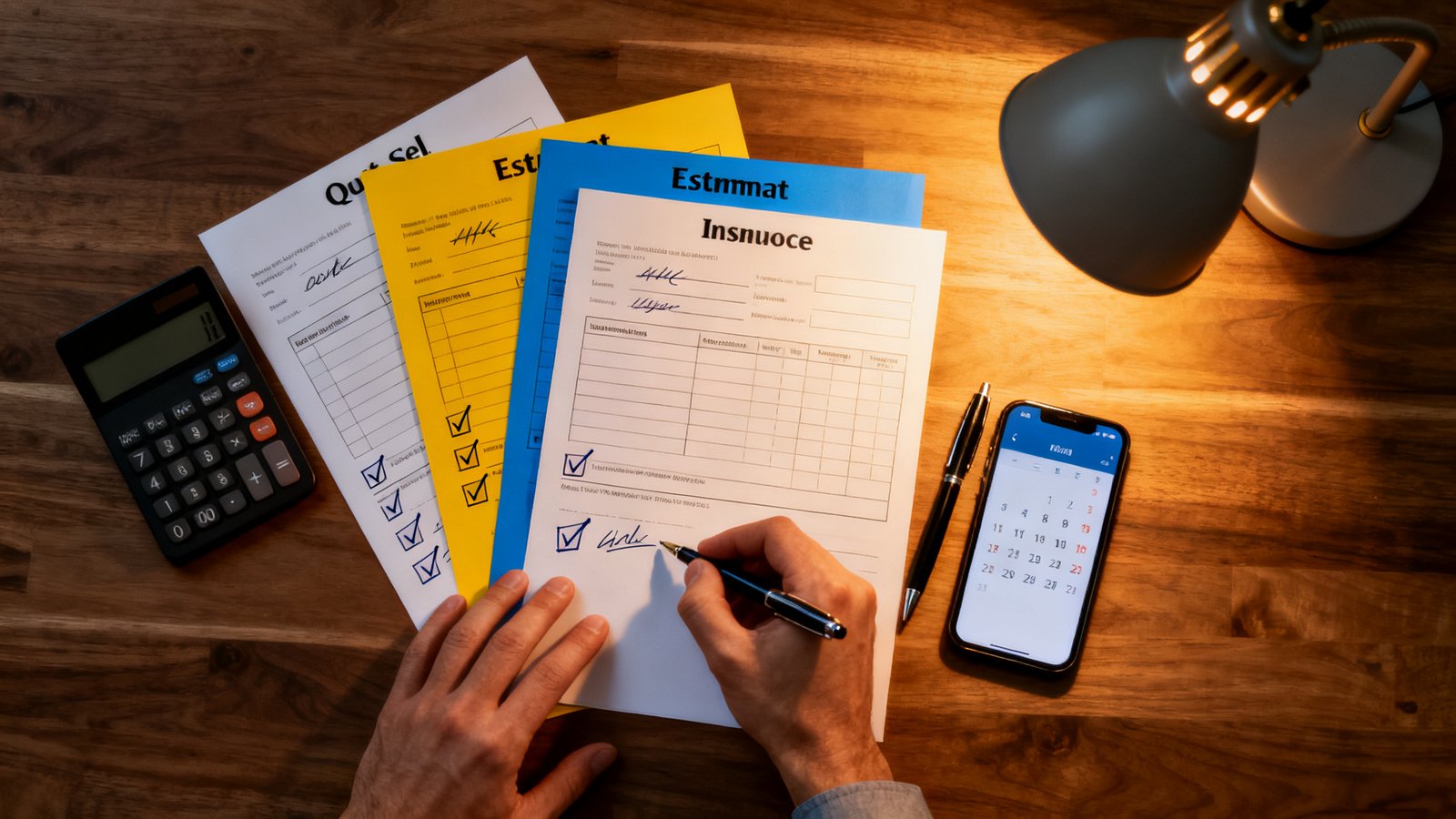
The real cost — how confusion and errors translate to lost revenue
The estimate vs invoice difference is not a semantic argument. It is a revenue protection issue. When you blur these documents, clients push back on payment, demand discounts retroactively, or simply refuse to pay what they think is an unfair surprise.
NetSuite’s research shows the hard numbers. Approximately 39% of invoices contain some form of error. Those errors trigger payment delays, admin hours spent reissuing corrected invoices, and outright disputes. The average company loses nearly $40,000 annually to late payments and disputes, and one in ten firms loses more than $100,000 annually to unpaid payments and disputes.
These figures apply to businesses across the board, and service based freelancers and tradespeople are especially vulnerable because they often work solo. There is no accounting department to catch mistakes. If you send five invoices a week and two have errors, you are hemorrhaging time and trust. Clean estimates that flow into accurate, matching invoices eliminate a massive percentage of these losses.
Think about a handyman who quotes jobs via text message. Without a formal handyman estimate template, the line items are vague, the final invoice number surprises the client, and a dispute begins. Multiply that by twenty jobs a month, and the lost revenue adds up fast.
Top mistakes that drive disputes (and how to fix each)
Most payment disputes are predictable. They follow the same pattern caused by the same mistakes. Here are the most common errors small business owners make with estimates and invoices, and how to fix each one before it costs you money.
Mistake 1: Inconsistent invoice numbering. Clients and accountants alike get suspicious when invoice numbers jump around or repeat. Fix: Use a sequential numbering system. Start with INV-001 and never skip or duplicate numbers.
Mistake 2: Unclear payment terms. Saying “payment due upon receipt” is vague. Fix: State an exact deadline. “Payment due within 14 calendar days of invoice date. Late payments accrue a 1.5% monthly finance charge.”
Mistake 3: Missing contact information. Invoices without a phone number, email, or physical address look unprofessional and delay payment when the client has a question. Fix: Always include your business name, address, phone, and email on every invoice.
Mistake 4: Vague scope descriptions. “Fix kitchen plumbing” is a disaster waiting to happen. Fix: Write specific line items. “Replace kitchen faucet with client supplied Moen model 87014. Includes removal of old fixture, installation, and leak test. Excludes drywall repair if access is required.”
Mistake 5: Delayed invoice sending. The longer you wait to send an invoice after completing work, the lower your chances of fast payment. Fix: Send the invoice within 48 hours of job completion, while the value is still fresh in the client’s mind.
Legal weight & binding questions — “Is an estimate legally binding?” (including verbal estimates)
A question that surfaces constantly in forums and small business groups is “is an estimate legally binding?” The general rule, per Bookstime, is that an estimate is not a binding contract. It is a proposal, an approximation. But the real world is messier than a one line rule.
If you give a client a written estimate and they sign it, and you both proceed as if that number is final, a court could view the conduct as creating an implied agreement. This is why smart business owners add explicit language to their estimates: “This estimate is valid for 30 days and is subject to change based on site conditions, material price fluctuations, or scope changes requested by the client. Final pricing will be confirmed via a signed change order or contract before additional work proceeds.”
Verbal estimates are even riskier. The provided research sources do not address the enforceability of verbal estimates in California, New York, or Texas specifically. This is a research gap. Because of this uncertainty, the conservative, revenue-protecting approach is to assume that verbal estimates can cause legal headaches and to never rely on them. Get everything in writing.
If you operate in CA, NY, or TX and have a dispute over a verbal estimate, consult a local attorney. State contract laws vary, and this article cannot offer state-specific legal advice. What we can offer is a practical rule: written and signed documents prevent the dispute from happening in the first place.
What to include in each document — fields checklist + sample templates
Most freelancers and tradespeople omit critical fields from their estimates and invoices because nobody taught them what belongs there. Here are the exact checklists.
Estimate fields checklist:
- Business name, address, phone, email
- Client name and contact information
- Estimate number (sequential)
- Date of estimate
- Expiration date (“Valid until __”)
- Description of work or services (itemized)
- Estimated total (range or approximate amount)
- Exclusions and assumptions (“Does not include __”)
- Terms: “This is an estimate, not a fixed price contract. Final invoice may vary based on __.”
- Client approval signature line
Invoice fields checklist:
- All business and client contact info
- Invoice number (sequential)
- Issue date and payment due date
- Reference to the estimate or quote number
- Description of work completed (itemized, matching estimate language when possible)
- Subtotal, any discounts, tax (if applicable), total amount due
- Payment methods accepted
- Late payment policy and any finance charge language
Patriot Software and Bookstime confirm that estimates typically omit payment terms and a final amount due, while invoices require these elements. The research does not specify exactly which fields are IRS-mandated, so consult a tax professional for compliance requirements specific to your business structure. At minimum, keep copies of every estimate and invoice for your records.
For service businesses that need fast, professional templates, our PDF estimate generator includes pre-built industry templates for roofing, HVAC, cleaning, handyman, electrical, pest control, landscaping, junk removal, and many more trades, with all required fields baked in.
Dispute prevention & resolution workflow (step-by-step)
Preventing payment disputes starts before you ever swing a hammer or open a laptop. Follow this chronological workflow on every single job.
1. Signed estimate or quote required. Never start work without written approval. Include scope, exclusions, and assumptions on the estimate itself. The approval can be a signed PDF or an email that says “I approve this estimate.”
2. Change order process locked in. When the client wants something extra, document it immediately. Send a one paragraph change order: “This change order adds [scope item] for an additional [dollar amount]. The new total will be [new total]. Please reply ‘Approved’ to proceed.” No reply, no extra work.
3. Milestone invoicing for larger projects. On jobs exceeding a few thousand dollars, break the invoice into two or three payments. Example: 30% deposit upon approval, 40% at midpoint milestone, 30% upon completion. This protects your cash flow and reduces the client’s exposure.
4. Clear payment terms on every invoice. State exactly when payment is due and what happens if it is late. Example language: “Invoice due 14 days from issue date. A late fee of 1.5% per month will be applied to overdue balances.”
5. Follow up cadence. Send a friendly reminder three days before the due date. Send a firm notice the day after the due date. Send a final notice with the late fee noted seven days after the due date. Most small businesses skip follow up entirely and then wonder why they are not getting paid.
Escalation template for late payers (14 days past due):
“Hi [Client Name], I wanted to follow up on invoice #INV-012, which was due on [date]. The balance of $[amount] remains unpaid. Please remit payment by [date 5 days from now] to avoid further late fees. If payment has already been made, please disregard this notice. Thank you.”
NetSuite identifies incorrect invoices, PO discrepancies, vague payment terms, unfinished services, quality issues, and miscommunications as common dispute causes. This workflow addresses every single one of those triggers before they ignite.
Gaps most articles skip — what this post must add
Most articles about the estimate vs invoice difference cover the surface definitions and stop. Three critical subtopics are almost always missing, and they are exactly what small business owners need most.
1. State specific enforceability caveats. The provided research sources do not supply state specific enforceability details for verbal estimates in California, New York, or Texas. This is a significant gap. The practical fix is straightforward: search “[your state] contractor estimate requirements” and check your state’s licensing board website. Some states require written estimates for auto repair or home improvement over certain dollar thresholds. Spending ten minutes on your state’s contractor licensing page can save you thousands in legal trouble.
2. Conservative modeling of freelancer revenue loss. No direct data exists on revenue lost specifically by freelancers who skip estimates. However, we can use proxy metrics conservatively. If the average business loses $40,000 annually to late payments and disputes, and a solo freelancer operating without written estimates experiences even a fraction of that revenue disruption, say 10 to 20 percent proportionally, the lost income is significant for a one person operation. Written estimates reduce this risk immediately by creating a paper trail and aligned expectations.
3. IRS-required invoice elements vs typical estimate omissions. The research does not specify which exact invoice fields the IRS requires versus what estimates omit. What we know with confidence is that the IRS requires businesses to keep records that clearly show income and expenses. Invoices should include enough detail to substantiate the transaction if audited. Estimates, which omit payment terms and final amounts, are not sufficient for tax records on their own. Keep copies of both so your estimate supports the invoice amount if questions arise.

FAQ — quick answers to high-volume long-tail queries
Can I convert an estimate to an invoice?
Yes, and you should. Many invoicing tools let you convert an approved estimate into an invoice with one click, carrying over all line items, client info, and pricing. This maintains consistency and reduces manual entry errors. Just ensure the estimate was approved first.
Is a quote legally binding?
Generally, yes, once the client accepts it. A quote is an offer to perform specific work at a fixed price. Acceptance creates a contract. If you provide a quote, be certain you can deliver the work at that price.
When should I send the invoice after work?
Send the invoice within 24 to 48 hours after completing the work or hitting a defined milestone. The faster you send it, the higher your odds of prompt payment. Delaying invoicing signals that payment timing does not matter to you.
Do estimates include tax?
Estimates often do not include tax because the final amount is not yet fixed. When tax applies, note on the estimate: “Sales tax will be added to the final invoice based on applicable rates.” This sets the expectation that the final invoice number will be slightly higher than the estimate subtotal.
Is a verbal estimate binding in CA, NY, or TX?
The provided research does not contain state specific guidance on verbal estimate enforceability in California, New York, or Texas. The conservative and safest practice is to never rely on verbal estimates. Always document pricing in writing and obtain approval before starting work. If you face a dispute over a verbal estimate, consult a local attorney.
How to handle scope creep?
Stop and document it immediately. When a client requests work outside the original estimate, send a change order describing the new work and the additional cost. Do not perform the extra work until the client approves the change order in writing. This single habit protects your profit margin on every job.
Templates & CTA — download quote/estimate/invoice templates + use the quote generator
You now know the estimate vs invoice difference, the exact workflow, the mistakes to avoid, and the gaps most articles skip. The quickest way to implement all of this is to use ready-made templates that already have the correct fields, disclaimer language, and professional formatting built in.
We have created free, downloadable templates for the three documents every service business needs: a polished quote template, a detailed estimate template, and a clean invoice template. Each one includes the fields checklist from this article and the wording that reduces disputes.
Which template to use in 3 common scenarios:
- Small fixed price job: Use a quote template. The scope is clear, the price is locked, and you want a binding agreement. Good for a house cleaning estimate or a one time landscaping job.
- Time and materials or uncertain scope: Use an estimate template. The price range gives flexibility while still aligning expectations. Ideal for handyman repairs, pest control treatments, or auto repair work where hidden damage might surface.
- Retainer or milestone project: Use a quote or estimate with a payment schedule, then invoice at each milestone. Perfect for freelance web design, large construction projects, or photography packages with deposits.
The 39% invoice error rate and average annual losses cited by NetSuite are not inevitable. They are the predictable cost of sloppy paperwork. Cleaner documents reduce your error and dispute risk immediately. Download the templates, use the free PDF estimate generator to create branded estimates, quotes, and invoices in minutes with no account required, and start protecting your revenue today.