
If you want to know how to write a job estimate that actually wins work instead of scaring clients away, the answer isn’t another generic template. It is knowing exactly which sections prevent disputes, what language signals professionalism, and where most new freelancers leave money on the table. Alex, if you have ever sent a price and then held your breath waiting for a reply, this guide fixes that.
Key Takeaways
- Label your document clearly as an estimate or quote before the client reads a single line item. This one decision determines whether you can adjust pricing later or are legally bound.
- Seven specific sections must appear in every document: header, scope, line items, totals, payment terms, expiration date, and a signature block. Omit any of these and dispute risk climbs sharply.
- Use the free estimate generator at the end of this guide to produce a branded, client-ready PDF in under three minutes. No account, no paywall, no learning curve.
- 1. Estimate vs. Quote: The Practical Difference and Why It Matters
- 2. 7 Must-Have Sections Every Professional Estimate or Quote Must Include
- 3. Line-Item Breakdown: How to Present Labor, Materials, and Markups
- 4. The Most Overlooked Items That Lead to Disputes and Exact Language to Fix Them
- 5. How Long Should an Estimate Be Valid? Industry Standard and Why
- 6. Pricing Strategy: Simple Ways to Price a Job Without Getting It Wrong
- 7. Presenting Terms and Payment: Reduce Late Payments and Scope Creep
- 8. Professional Layout and Language: What Separates Amateur from Hire-Ready
- 9. Sample Templates: 3 Ready-to-Copy Formats
- 10. Common Mistakes Newbies Make and Exact Edits to Fix Them
- 11. When to Convert an Estimate into a Formal, Binding Quote
- 12. Acceptance, Signatures, and Digital Options
- 13. Tools, Templates, and a Free Estimate Generator
- 14. Quick Checklist and One-Page Cheat Sheet
- 15. FAQ: Short Answers to Common Questions
- 16. Closing: Next Steps for the Reader
Estimate vs. Quote: The Practical Difference and Why It Matters
An estimate is a ballpark figure. It says, “Here is roughly what this will cost, but the final number might shift.” A quote is a fixed, binding price. Once the client accepts a quote, you are locked in. If material prices spike or the job takes longer than expected, you eat the difference.
This distinction is not academic. Research from Projul shows that failure to clarify the document type causes misunderstandings and disputes. A client who thinks they received a binding quote will fight a change order. A client who knows they received an estimate expects some flexibility. The fix is simple: put the label in the header. “Estimate” or “Quote.” Not “Proposal.” Not “Bid.” Pick one and make it obvious.

When should you send each? Use an estimate early in a conversation when the scope is still fuzzy. Use a quote when the project is fully defined and you are ready to commit. If you are a handyman quoting a deck repair and the client might add more work, start with an estimate. If you are a freelance developer building a five-page website with fixed deliverables, send a quote. Labeling correctly is the cheapest insurance policy you will ever buy.
7 Must-Have Sections Every Professional Estimate or Quote Must Include
Every professional estimate shares a skeleton. Skip one bone and the whole thing wobbles. Here are the seven sections that belong in every document you send, whether you use a handyman estimate template or build your own from scratch.
1. Header with company and client information. Your legal business name, address, phone, email, and the client’s matching details. This sounds obvious, but if a dispute escalates, you need a clear record of who the parties are. Include the date the estimate was prepared and a unique estimate number for tracking.
2. Scope of work and line items. Describe what you will do in plain, specific language. “Repair drywall in living room” beats “fix wall.” List each task as its own line item so the client sees exactly what they are paying for. This section is your primary defense against scope creep.
3. Quantities and unit prices. Show the math. If you are painting, list square footage. If you are building, list materials by unit. Clients trust transparency. A single lump sum with no breakdown looks like a guess, even when it is accurate.
4. Labor and materials separated. Break out labor hours, hourly rate, and material costs. This makes price negotiations easier because you can discuss each bucket independently. It also helps when material prices fluctuate and you need to apply a surcharge.
5. Subtotal, taxes, and total. Show the arithmetic. Subtotal before tax, tax as its own line, and a bold total at the bottom. Do not bury the final number in a paragraph.
6. Payment terms and validity period. State when payment is due, how it should be made, and how long the price is good for. Industry standard for estimate validity is 30 days, according to Rocketlane’s price quote research. After 30 days, material costs, subcontractor availability, and your own schedule may have changed.
7. Signature and acceptance block. This is the most important section that new freelancers skip. A line for a signature and date turns your estimate from a suggestion into a mutual agreement. Without it, you are working on a handshake, and handshakes do not hold up in small claims court.
The most common omissions that cause disputes, based on research findings, are expiration date, exclusions, signature before starting work, clear document type, and an assumptions list. Every one of these belongs in your document.
Line-Item Breakdown: How to Present Labor, Materials, and Markups
Clients do not want to see a single number. They want to understand value. A line-item breakdown shows exactly where their money goes and reduces the impulse to haggle. Here is a realistic example for a small bathroom refresh:
| Item | Qty | Rate | Total |
|---|---|---|---|
| Remove existing vanity and mirror | 1 | $85.00 | $85.00 |
| Install new 30″ vanity (client supplied) | 1 | $150.00 | $150.00 |
| Plumbing adjustments and new P-trap | 1 | $95.00 | $95.00 |
| Drywall repair around vanity area | 1 | $60.00 | $60.00 |
| Paint walls (2 coats, 10′ × 8′ area) | 1 | $120.00 | $120.00 |
| Materials: P-trap, drywall patch, paint, supplies | 1 | $65.00 | $65.00 |
| Total | $575.00 |
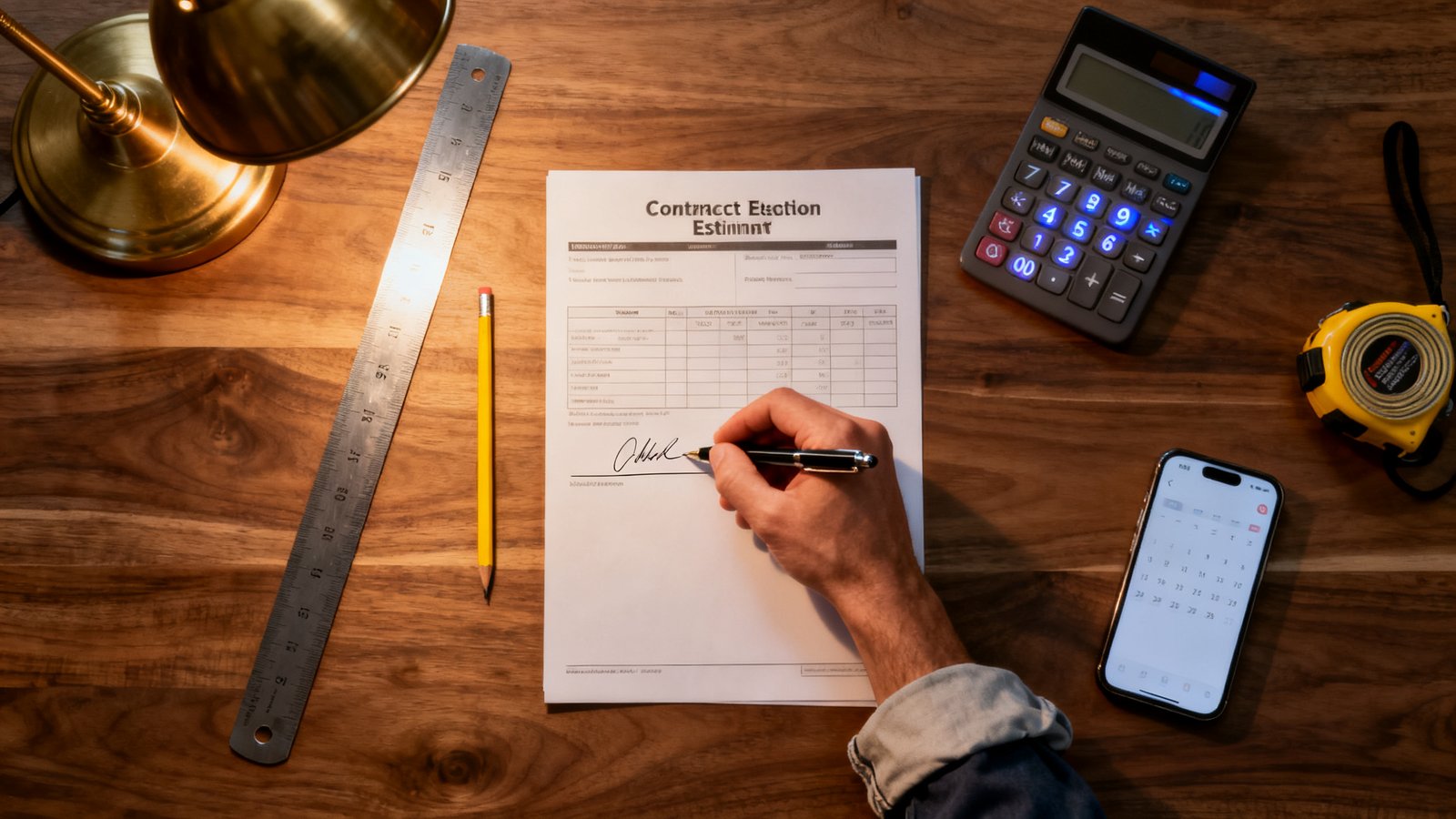
Notice what this breakdown does. It shows labor separated from materials. It identifies which items the client supplied versus what you are providing. It uses exact quantities. And the total is bold and unmistakable. This format works for any trade. A cleaning quote template uses rooms instead of tasks. A freelance quote template uses phases and hours. The principle is identical: show the work, show the math, make the total obvious.
In professional services, omitting effort in hours or phases, or failing to specify the resource mix like senior versus junior team members, leads to budget overruns and staffing conflicts, according to Rocketlane’s analysis of service pricing. The same logic applies to contracting. Show hours. Show who is doing the work. Show what materials cost. Do not make clients guess.
The Most Overlooked Items That Lead to Disputes and Exact Language to Fix Them
Based on research across multiple industry sources, five items are consistently omitted from estimates and quotes, and these omissions are the root cause of most disputes. Here is each gap with copyable language you can drop into your next estimate.
1. Expiration date. Without it, a client can come back eight months later expecting the original price after material costs have shifted 20%. Insert this line below your total:
“This estimate is valid for 30 days from the date above. Pricing may change after that period due to material cost fluctuations and schedule availability.”
2. Exclusions. If you do not say what is not included, clients assume everything is covered. Be specific:
“This estimate does not include: permit fees, dumpster rental, drywall repair beyond the vanity area, paint for rooms other than the bathroom, or any electrical work. Any additional work discovered during the project will be documented in a separate change order.”
3. Assumptions. This is described by Blaze Estimating as the most underused and yet vital document in construction estimating. List every assumption that is not explicit elsewhere:
“Assumptions: Site access is available during normal business hours (8am to 5pm, Monday through Friday). Existing electrical and plumbing infrastructure is in functional condition. Client will provide vanity and mirror on site before the start date. No hazardous materials (asbestos, lead paint) are present.”
4. Signature before starting work. Relying on a verbal go-ahead is a primary cause of payment disputes. Add this below the total:
“By signing below, you accept this estimate and authorize work to begin. A 30% deposit of $____ is required before the start date. Signed: ____________ Date: ____________”
5. Clear document type label. As covered earlier, the word “Estimate” or “Quote” must appear prominently in the header. Do not use ambiguous terms like “Proposal” or “Bid” unless you define them clearly.
How Long Should an Estimate Be Valid? Industry Standard and Why
Thirty days. That is the standard answer in 2026, supported by both Projul and Rocketlane research. But the real question is why 30 days and when to deviate.
A 30-day window protects you from material price swings. Lumber, copper, and electrical components can fluctuate 10 to 20 percent in a matter of weeks. If a client sits on your estimate for two months and then asks you to honor it, you lose money or you have an awkward conversation. The expiration date prevents both outcomes.
Shorten the window to 7 or 14 days when quoting jobs with volatile materials like roofing or when subcontractor availability changes fast. Extend it to 60 days for remote freelance work where your costs are primarily labor and do not shift with commodity markets. Just put something. An estimate with no expiration date is an open liability.
If a client asks you to extend an expired estimate, treat it as a new estimate. Recheck your material prices, confirm subcontractor availability, and reissue with a fresh date. Clients respect this because it shows you are running a real business, not guessing.
Pricing Strategy: Simple Ways to Price a Job Without Getting It Wrong
Pricing scares new freelancers more than any other part of the process. The fear of charging too much and losing the job sits right next to the fear of charging too little and working for free. Here are four straightforward methods to anchor your numbers.
Time and materials. Charge an hourly rate plus the cost of materials with a small markup or none. Best for unpredictable work like repairs where you cannot see the full scope until you open a wall. Clients get transparency. You get paid for every hour you work.
Fixed price. A single number for a defined scope. Best for projects with clear deliverables, like a five-page website or a bathroom vanity replacement. Higher risk for you if the scope creeps, so your exclusions and assumptions must be tight.
Unit pricing. Charge per square foot, per window, per room. Landscapers and painters use this effectively. It lets clients scale up or down without renegotiating the whole deal.
Cost plus contingency. You charge actual costs plus a fixed percentage for your overhead and profit. Common in larger construction projects. Requires trust and transparent receipts.
The time investment scales dramatically with accuracy. A preliminary estimate using 30 to 50 percent complete documents takes roughly 8 to 16 hours and lands within plus or minus 15 to 30 percent accuracy. A full bid estimate with 100 percent complete documents takes 40 to 80 hours and delivers plus or minus 2 to 5 percent accuracy, according to Blaze Estimating’s construction guide. Do not spend 40 hours on a $400 job. Match the effort to the stakes.
For a quick pricing worksheet, use this formula: Materials cost plus (hours times your hourly rate) plus any subcontracted line items, then add a contingency percentage if the job exceeds $2,000, then add tax if applicable. That is your subtotal. If you use a contractor quote template, this math is built into the structure already.

Presenting Terms and Payment: Reduce Late Payments and Scope Creep
Payment terms are where professionalism earns its keep. A vague “pay when done” turns into “pay three months later, maybe.” A clear schedule locks in cash flow. Here is a sample payment schedule that works for mid-sized jobs:
Sample Payment Schedule
30% deposit due upon acceptance, before work begins
30% due at project midpoint (define the milestone, like “drywall installed” or “Phase 2 deliverables sent”)
40% due upon completion, before final walkthrough or handoff
Specify how clients can pay. Bank transfer, check, credit card, or payment platform. If you charge a processing fee for cards, disclose it. Add a late fee clause: “Payments not received within 15 days of the due date are subject to a 1.5% monthly late fee.” This rarely gets enforced but strongly incentivizes on-time payment.
Change orders deserve their own process. When a client asks for something outside the original scope, do not just do it and bill later. Write a one-paragraph change order, get it signed, and attach it to the original estimate. This is how experienced contractors and professional estimate users avoid the most common source of end-of-project arguments. Missing a signature or clear acceptance before work begins is, per the research, a primary cause of payment disputes.
Professional Layout and Language: What Separates Amateur from Hire-Ready
Layout is not about being fancy. It is about being clear. A client who cannot find the total, the expiration date, or the signature line is a client who will not sign. Here is a layout checklist that takes five minutes to apply:
- Your company name and logo at the top, left aligned
- Estimate number and date, right aligned
- Document type label in bold, 16pt or larger, right under the header
- Client name and contact information, clearly separated from your info
- Line items in a table with visible column headers
- Subtotal, tax, and total in a shaded summary box at the bottom
- Payment terms, expiration, exclusions, and assumptions in labeled paragraphs
- Signature block with a line and date field
- One font, maximum two weights, no clip art, no neon colors
Language should be plain English. Do not write “heretofore” or “party of the first part.” Write “client” and “contractor.” Write “you pay” and “we do.” If a term is legally necessary, explain it in parentheses the first time. The goal is not to sound like a lawyer. The goal is to be understood so clearly that nobody can later claim they misunderstood.
Evidence on the exact percentage of clients who refuse to hire due to unprofessional layout is limited. But every source consulted emphasizes that a professional and clear document is critical for winning work. In a market where many freelancers still quote via text message, a clean PDF sets you apart instantly. Using a PDF estimate generator free tool ensures your formatting is consistent every time.
Sample Templates: 3 Ready-to-Copy Formats
Below are three templates you can adapt. Each includes the essential sections and sample numbers so you can see the structure immediately.
Template 1: Quick Estimate (Ballpark)
ESTIMATE #E-2026-041
Date: April 7, 2026 | Valid: 30 days
Prepared for: Jane Doe, 123 Main St.
Scope: Replace kitchen sink faucet and supply lines. Remove old faucet, install client-supplied new faucet, replace two supply lines, test for leaks.
Estimated Total: $220 – $310
This is a preliminary estimate only. Final cost may vary based on condition of existing plumbing. A firm quote will be provided after inspection.
Exclusions: Countertop repair, drain line work, water filtration systems.
Assumptions: Shutoff valves are functional. Client supplies the new faucet.
Accepted: ____________ Date: ____________
Template 2: Detailed Fixed Quote (Line Items with Terms)
QUOTE #Q-2026-118
Date: April 7, 2026 | Valid: 30 days
Prepared for: Acme Consulting LLC
Project: Five-page business website redesign
| Discovery and wireframes (8 hours) | $640 |
| UI design (16 hours) | $1,280 |
| Front-end development (20 hours) | $1,600 |
| CMS integration and testing (6 hours) | $480 |
| Total | $4,000 |
Payment: 50% deposit ($2,000) due at signing. 50% ($2,000) due at launch.
Exclusions: Copywriting, photography, SEO services, hosting fees, domain registration, post-launch support beyond 14 days.
Assumptions: Client provides brand assets and content within 10 business days of request. Review cycles limited to two rounds per phase.
Accepted: ____________ Date: ____________
Template 3: Construction-Style Bid (with Assumptions and Exclusions)
BID #B-2026-203
Date: April 7, 2026 | Valid: 30 days
Project: 200 sq ft deck replacement with composite decking
Scope: Demolish and dispose of existing wood deck. Install new pressure-treated framing, composite deck boards, and railings. All fasteners stainless steel.
| Demolition and disposal | $800 |
| Framing lumber and hardware | $1,200 |
| Composite decking (Trex Enhance, 200 sq ft) | $2,400 |
| Railing system (40 linear ft) | $1,100 |
| Labor (4 days, 2 crew) | $3,200 |
| Contingency (5%) | $435 |
| Total Bid | $9,135 |
Exclusions: Permit fees, landscaping or sod repair around deck area, staining or sealing of composite material, electrical work for deck lighting, any structural repairs to the house ledger board beyond standard reinforcement.
Assumptions: Existing footings are code-compliant and will be reused. Site access is unobstructed with a minimum 36-inch path. No hazardous materials present. Weather delays beyond 48 consecutive hours may extend the schedule without penalty.
Payment: 30% deposit ($2,740) at signing. 30% ($2,740) at framing completion. 40% ($3,655) at substantial completion, before final cleanup.
Accepted: ____________ Date: ____________
The assumptions list appears in all three templates because Blaze Estimating describes it as the most underused and yet vital document in the entire estimating process. Use it heavily.
Common Mistakes Newbies Make and Exact Edits to Fix Them
Based on the research, here are the top errors early-stage freelancers make when learning how to write a job estimate, with the specific edits that fix each one.
Error: No expiration date. Your estimate floats in limbo forever.
Fix: Add “This estimate is valid for 30 days from the date above” directly below the total.
Error: No exclusions section. Client assumes everything is included.
Fix: Add a section labeled “Exclusions” and list everything you are not doing. Be specific. “Not included: painting, permits, dumpster rental.”
Error: No signature line. Work begins on a verbal agreement.
Fix: Add “Accepted by: ____________ Date: ____________” at the bottom and do not lift a finger until it is signed.
Error: Vague scope. “Fix bathroom” instead of “Replace vanity, patch drywall, paint 80 sq ft.”
Fix: Write the scope as if you are explaining it to someone who has never seen the room. Use measurements, quantities, and specific materials.
Error: No assumptions listed. You assume the site has power and water. The client does not know you assumed that.
Fix: Write down every assumption. Site access during business hours, functional utilities, client-supplied materials timeline. If it is not written down, it does not exist.
Error: Missing effort and hours in professional services. “Build a website, $4,000” with no breakdown.
Fix: Show phases with estimated hours. Discovery (8 hours), design (16 hours), development (20 hours). Clients can then understand what drives the cost.
The top three gaps found across competitor guides are missing or vague expiration dates, skipping exclusions entirely, and underusing the assumptions list. Address these three and you are ahead of most freelancers quoting today.
When to Convert an Estimate into a Formal, Binding Quote
An estimate is a starting point. A binding quote is a commitment. The trigger to convert is when the scope becomes firm and the client is ready to sign. Here is a practical workflow:
- Send a preliminary estimate based on the client’s description or a quick site visit. Label it clearly as an estimate. Include a note that a formal quote requires a detailed assessment.
- If the client likes the ballpark number, schedule a full scope walkthrough or discovery session. Take measurements, confirm materials, identify any site conditions that affect the work.
- Build the formal quote with line items, exclusions, assumptions, payment terms, and a signature block. The time investment jumps significantly here. A preliminary estimate takes 8 to 16 hours to produce with plus or minus 15 to 30 percent accuracy, while a binding bid estimate takes 40 to 80 hours and delivers plus or minus 2 to 5 percent accuracy.
- Send the quote with the 30-day validity window. If the client signs, you are locked in. If they delay past 30 days, reprice before honoring it.
Do not skip the estimate step and jump straight to a binding quote unless the project is small and fully defined. The estimate protects you from spending 40 hours pricing a job the client never intended to start. Use it as a filter. Serious clients move from estimate to quote. Tire kickers never do.
Acceptance, Signatures, and Digital Options
A signature turns your estimate into a contract. Digital signatures carry the same legal weight as ink in most jurisdictions, and they speed the process dramatically. Options include DocuSign, HelloSign, Adobe Sign, or even a typed name with a timestamp if both parties agree.
If you use a freelance quote template or any professional estimate tool, include a clear call to action: “To accept this quote, sign below and return within 7 days. A 30% deposit is required before work begins.” Make the next step so obvious that the client cannot misunderstand what to do.
Once the estimate is signed, attach it to your project file, your invoicing system, or your CRM. The signed document is your reference point for every future conversation about scope and payment. If a dispute arises, you pull out the signed estimate and point to the exclusions, assumptions, and payment terms. Without a signature, you point to nothing. Research identifies the lack of a signature before starting work as a primary cause of payment disputes.
Tools, Templates, and a Free Estimate Generator
You do not need to build estimates from scratch. The PDF Estimate Generator at PDF Estimate lets you select your industry, fill in your details, and download a branded PDF instantly. No account required. No paywall. It supports over 14 industries including roofing, HVAC, cleaning, electrical, plumbing, landscaping, handyman services, and freelance work.
For industry-specific templates, these free options include all the sections covered in this guide:
- Free roofing estimate template with line items for shingles, underlayment, flashing, and labor
- Handyman estimate template for small to medium repair jobs
- Plumbing estimate template with fixture and pipe replacement line items
- HVAC estimate template for system replacements and seasonal maintenance
Millions of new freelancers enter the market every year with zero quoting training. A working generator closes the gap between knowing what belongs in an estimate and actually producing one. Fill in the fields, download the PDF, send it to the client. Done.
Quick Checklist and One-Page Cheat Sheet
Print this or keep it open as you prepare your next estimate. Every box should be checked before you hit send.
☐ Document type labeled: “Estimate” or “Quote” in the header
☐ Company info: Legal name, address, phone, email
☐ Client info: Full name, address, contact
☐ Estimate number and date: Unique, trackable
☐ Scope of work: Specific tasks, measurements, deliverables
☐ Line items: Broken out with quantities and unit prices
☐ Labor and materials: Separated and clearly labeled
☐ Subtotal, tax, total: Bold total, easy to find
☐ Payment terms: Schedule, deposit, accepted methods, late fees
☐ Expiration date: 30 days standard, adjusted if needed
☐ Exclusions: Everything not included
☐ Assumptions: Every condition you are counting on
☐ Signature block: Line for name, signature, and date
☐ Call to action: Clear instruction for how to accept
Research consistently shows that omitting the expiration date, exclusions, signature, and assumptions list is the leading root cause of disputes. This checklist eliminates those gaps.
FAQ: Short Answers to Common Questions
Do I need to show tax on my estimate?
If you are required to collect sales tax in your jurisdiction and the work is taxable, yes. Show tax as its own line item. If you are not sure whether your service is taxable, check with your state’s department of revenue. Many services like freelance design or consulting are not taxed in certain states. Do not guess.
What if material prices change after I send the estimate?
If the estimate is still within its validity period and you labeled it as an estimate, you can adjust the final price and explain why. If you sent it as a binding quote, you are locked in. This is why the estimate versus quote distinction matters so much. For long projects, include a material price escalation clause.
Can I invoice before the client signs the estimate?
No. Do not invoice, do not schedule, and do not buy materials until the estimate is signed. A signed estimate is your authorization to proceed. An unsigned estimate is just a suggestion. Invoicing before acceptance creates confusion and weakens your position if a dispute arises.
How long should estimates be valid?
Thirty days is the standard in 2026. Shorten to 7 to 14 days for jobs with volatile material costs like lumber or roofing. Extend to 60 days for labor-only freelance work where your costs are stable. Always include an expiration date. An estimate without one is an open-ended liability.
Should I charge for estimates?
Most contractors and freelancers provide estimates for free as part of the sales process. However, if the estimate requires significant time like a full day site visit, detailed measurements, or architectural consultation, it is reasonable to charge a fee that is credited toward the project if the client proceeds. Disclose this upfront.
Closing: Next Steps for Alex and Every New Freelancer
You now know exactly how to write a job estimate that protects your business, converts prospects, and gets you paid on time. The difference between an amateur quote and a professional one is not design talent or expensive software. It is the presence of seven specific sections, clear language, an expiration date, and a signature line.
Here is your three-step action plan for today:
- Use the generator. Go to the PDF Estimate Generator, select your industry, fill in the fields, and download a branded PDF. This takes under three minutes and produces a document formatted correctly from the first use.
- Run a mock quote. Pick a hypothetical project for your trade and build a complete estimate using the checklist above. Include line items, exclusions, assumptions, payment terms, and a signature block. Read it as if you were the client. Does every sentence make sense? Is the total obvious? Are the exclusions clear?
- Send and track. The next time a real prospect asks for pricing, send your estimate within 24 hours. Note the expiration date in your calendar. Follow up three days before it lapses. When the client signs, attach the document to your project file and invoice per the payment schedule.
Every estimate you send that includes an expiration date, exclusions, assumptions, and a signature block dramatically reduces your dispute risk. Every estimate that skips those items leaves you exposed. The choice is straightforward. Start with the generator, customize from there, and never send a bare number by text message again.