
Most independent handymen searching for a handyman estimate template free of complicated software have felt the same frustration. You finish a call with a potential client, then stare at your phone wondering whether to text a number or spend twenty minutes wrestling with a bloated app. The middle ground, a fast, professional, single page PDF you can fill out and send in under five minutes, feels impossible to find. It is not. This guide shows you exactly how to stop undercharging, look established, and convert more odd jobs into signed work, using a straightforward template and a repeatable pricing method.
Key Takeaways
- A clean, itemized estimate signals professionalism and prevents the scope creep that eats into your margin on small repairs.
- Most free templates skip three critical fields: the service call fee, a real labor time breakdown, and an expiration date with clear exclusions.
- Using a fillable PDF and a simple pricing formula (call out fee plus itemized labor blocks plus materials with markup) can shrink your quoting time to under five minutes while protecting your profit.
- Why a clean, itemized estimate wins more jobs
- The three fields most free templates miss (and why they matter)
- Simple pricing structure to stop undercharging (how to itemize in 60 seconds)
- The one page fillable PDF: fields, layout, and copy (download ready)
- Sample line items and preset language (fill in the blank blocks)
- Send workflow: from initial text to signed PDF in 24 to 48 hours
- Handling objections and platform pitfalls (how to avoid free estimate confusion)
- Track two KPIs and why you must split by job size
- Closing CTA: downloadable free PDF plus 60 second setup checklist
- Frequently asked questions
Why a clean, itemized estimate wins more jobs
When a homeowner receives two responses for the same faucet repair, one is a text that reads “probably around $200” and the other is a single page PDF listing the service call, labor time, materials, and total, the second contractor gets the nod almost every time. Even if your price is slightly higher, the document itself does the selling. It tells the client you have done this before, you know what things cost, and you are not guessing.

The opposite approach, sending informal text estimates, creates three problems. First, it invites haggling because a single number with no breakdown looks arbitrary. Second, it offers zero protection against scope creep. When the client later adds “while you are here” tasks, you have no reference document showing what the original price covered. Third, and most costly, it causes chronic undercharging. Sources consistently warn that vague, non itemized estimates lead to underbidding and lost profit. Handymen also tend to underestimate project time by roughly half due to the planning fallacy, so doubling your time estimate is a practical safeguard against accidentally working for minimum wage.
A professional looking estimate also signals that you carry insurance, have a business structure, and will show up on time. Those signals matter more than having the lowest number. If you have ever used a free estimate template PDF generator before, you already know how much faster a prebuilt format makes the process. The goal here is to build one specifically for handyman work, with the fields and line items that actually close small jobs.
The three fields most free templates miss (and why they matter)
Most generic estimate templates were designed for large contractors running multi week projects. They include plenty of space for change orders and subcontractor line items but skip the details that matter on a $350 odd job. Here are the three fields that go missing, and the real dollar impact of each.
First, the service call or trip charge. This flat fee covers your drive time, fuel, vehicle wear, and the simple fact that showing up is half the job. Without it, a thirty minute repair that requires forty minutes of round trip driving becomes unprofitable before you pick up a tool. A minimum service charge also filters out tire kickers who want free assessments. Many successful handymen set this between $45 and $95 depending on their metro area.
Second, a detailed labor time breakdown. A single line reading “Labor: 2 hours” tells the client nothing and leaves you exposed if the job runs long. Break it into blocks: drive time, setup and protection, the actual repair, cleanup, and any hardware store run. When clients see the breakdown, they understand why a “quick fix” still bills for a half day. Research identifies this as one of the top omissions in handyman estimating tools, free and paid alike.
Third, exclusions and an expiration date. A sentence stating what the estimate does not include (permits, structural repairs, materials beyond what is listed) prevents disputes later. The expiration date, typically 15 or 30 days out, protects you from material price swings and calendar fill ups. Templates from sources like BuildWithDave highlight that these disclaimers are among the most frequently overlooked fields, yet they cost nothing to add and save hours of uncomfortable conversation.
Each missing field represents either lost revenue or future conflict. Adding all three takes roughly forty seconds on a properly designed template.
Simple pricing structure to stop undercharging (how to itemize in 60 seconds)
Most handymen undercharge not because their hourly rate is too low, but because they forget to bill for everything surrounding the actual repair. A repeatable pricing formula solves this. Here is the structure that works for odd jobs, small repairs, and single day projects.
Start with a service call fee. This is non negotiable and covers showing up. Next, list labor in thirty minute or one hour blocks with a clear description of what each block includes. Then add materials at cost plus a markup, typically 20% to 35%, to cover sourcing time and carrying costs. Finally, add a small overhead or profit line, even just 10%, so every job contributes to your business beyond your personal wages.
Here is example math for a typical small job, replacing a kitchen faucet. Service call: $65. Labor block (faucet replacement, up to 2 hours including cleanup): $160. Materials (faucet supplied by client, miscellaneous fittings): $22 with 25% markup equals $28. Overhead and profit at 10%: $25. Total estimate: $278. Without this structure, the same handyman might text back “around $200,” work three hours when complications arise, and net roughly $45 after costs.
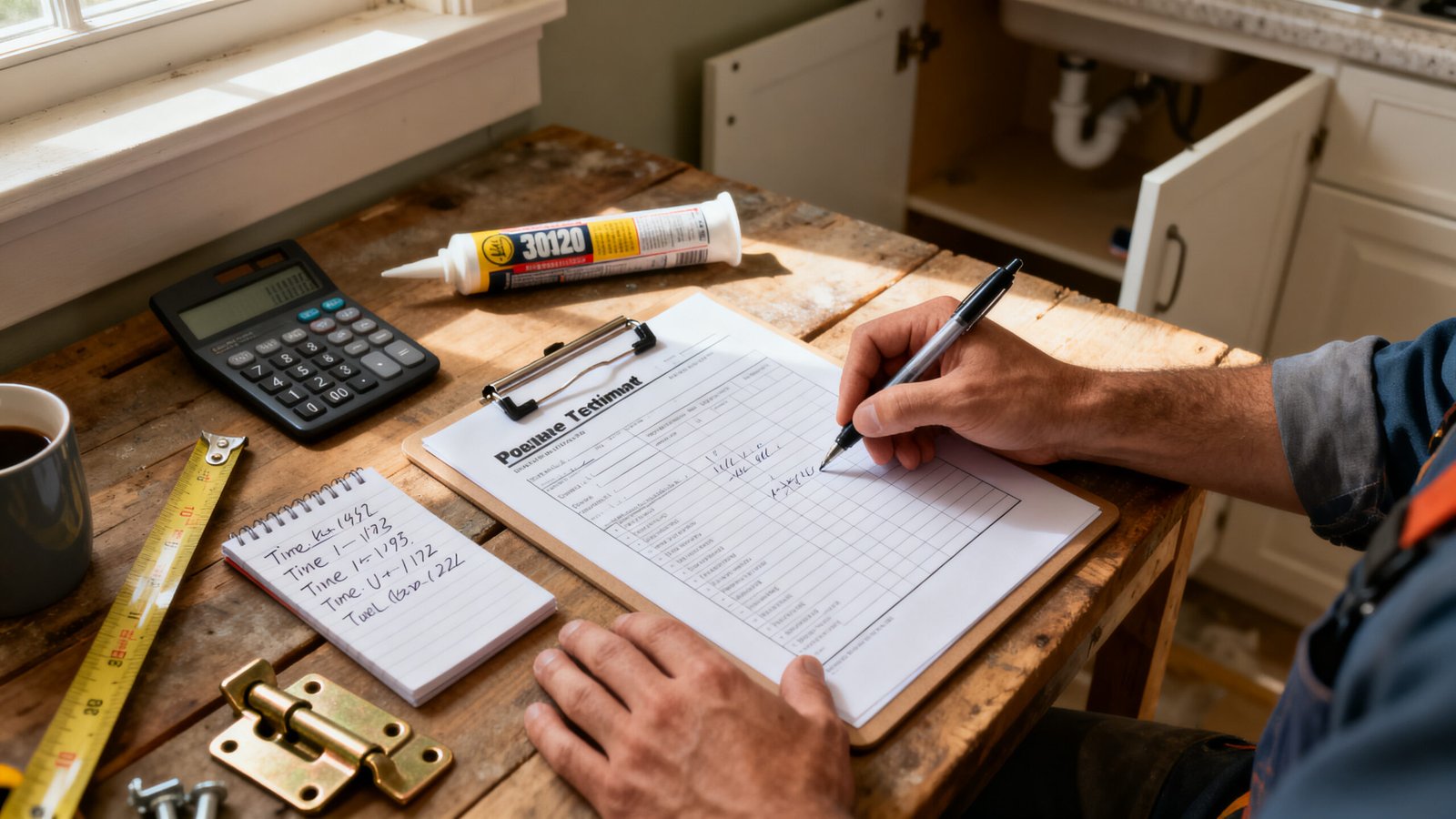
This approach also makes your handyman service estimate consistent across clients. When every job uses the same line item logic, you stop accidentally giving discounts to friendly homeowners while charging full price to difficult ones. Consistency builds confidence, and confidence raises your average ticket.
The one page fillable PDF: fields, layout, and copy (download ready)
The ideal handyman estimate fits on a single page. Everything the client needs to understand the scope, price, and terms lives above the fold. Here is the exact field list and microcopy for a template you can fill and send in under five minutes.
At the top left, place your business name, phone number, email, and license number if applicable. Top right gets the estimate number, date, and expiration date. Below that, a client info block with name, address, phone, and a short job location note. Then a three line job summary: what the client requested, what you observed during the walkthrough, and any assumptions the estimate relies on.
The itemized line items section forms the core of the page. Columns: description, quantity or time, unit price, and line total. Rows for service call, each labor block, materials, disposal if applicable, and the overhead or profit line. Below that, a bold total line, payment terms (due upon completion, 50% upfront for materials over $200, or net 7 for property management clients), and a signature block for both parties.
Multiple sources imply that clean, detailed estimates build trust and close jobs faster, making a simple PDF the recommended format. If you have explored other trades’ templates like a free roofing estimate template or an HVAC quote template PDF, you will recognize the structure. The handyman version just strips away the multi crew complexity and keeps things tight.
Sample line items and preset language (fill in the blank blocks)
Typing the same descriptions over and over wastes time. Here are six common line items and five ready to paste clauses you can drop into any estimate.
Common line items for odd jobs and small repairs:
Service call or trip charge: Flat fee covering travel to the job site, initial assessment, and basic tool setup. Typically $45 to $95.
Hourly labor or labor block: Itemized by task. “Drywall patch, tape, and texture (up to 2 hr)” at a fixed block price.
Materials with markup: List each material line separately or as a grouped entry. Include the markup percentage in the description so clients know it includes sourcing time.
Disposal or haul away: Line item for removing old fixtures, debris, or packaging. Charge by the bag, by weight, or as a flat fee.
Permit coordination or specialty work: If the job requires pulling a permit or subcontracting a licensed electrician, list it separately with a note.
Travel beyond service area: Additional mileage or time charge for jobs outside your standard radius.
Five preset clauses to paste into every estimate:
Exclusions: “This estimate includes only the work described above. Any additional repairs discovered during the job will be quoted separately for approval before proceeding.”
Expiration: “This estimate is valid for 15 calendar days from the date shown. Prices may change after expiration due to material cost fluctuations or schedule availability.”
Payment terms: “Payment is due upon completion of work unless otherwise agreed in writing. For material costs exceeding $200, a 50% deposit is required to schedule the job.”
Warranty: “Labor is warranted for 90 days from completion. Manufacturer warranties on materials apply per the manufacturer’s terms. This warranty does not cover damage from misuse, preexisting conditions, or work performed by others.”
Next steps: “To accept this estimate, sign below and return via email or text. Work will be scheduled within 3 business days of receipt of the signed estimate and any required deposit.”
These blocks, pulled from common template omissions flagged in industry research, prevent the exact gaps that cause disputes. Keeping them saved in a notes app or a cleaning quote template style format makes copying and pasting painless.
Send workflow: from initial text to signed PDF in 24 to 48 hours
Many handymen currently quote via text messaging. That habit is not a problem to eliminate, it is a starting point to upgrade. Here is a practical standard operating procedure that respects how you already work while introducing a professional document at the right moment.
Step one: initial contact. A lead comes in via app, call, or referral. Ask two qualifying questions and request photos if the client has not already sent them. If the job sounds straightforward and within your typical range, send a ballpark range via text. Keep it wide. “Kitchen faucet replacements typically run between $240 and $320 depending on access and any surprises underneath the sink.”
Step two: schedule the visit or confirm by photo. If the job is small enough to estimate from photos and a short conversation, do so. Otherwise, schedule a quick site visit. Charge for this visit if your policy is paid assessments. Let the client know the estimate document will follow.
Step three: fill and send the PDF. After the visit or photo review, complete your single page template. Export it as a PDF. Send it via email or text with a short message: “Here is the estimate for the kitchen faucet replacement we discussed. It covers the service call, labor, and listed materials and is valid for 15 days. Let me know if you have any questions and I will get you on the schedule.”
Step four: follow up. If you have not heard back in 48 hours, send a brief follow up message. “Wanted to check in on the faucet estimate I sent Tuesday. Happy to adjust anything or answer questions. I have availability Thursday and Friday this week.”
This workflow accepts that texting is part of handyman life but places the formal handyman quote template PDF at the center of the commitment step. The text starts the conversation. The PDF closes it.
Handling objections and platform pitfalls (how to avoid free estimate confusion)
One recurring problem on lead platforms like Thumbtack involves the phrase “free on site estimate.” Some customers interpret this to mean the assessment, diagnosis, and even preliminary repair work should all be free. Feedback from contractors on the platform highlights that customers become confused, believing a licensed professional will provide detailed analysis and a repair plan at no charge, when in reality the estimate itself is free but the diagnostic time is billable work.
| What the client hears | What it actually means | How to rephrase it |
|---|---|---|
| “You will come out and tell me exactly what is wrong, for free.” | The estimate document is free. Diagnostic time may have a fee, credited toward the job if hired. | “I provide a free written estimate. If the job requires diagnostic work to determine the scope, that time is billed at my standard rate and credited back if we proceed.” |
| “You will give me a price on the spot, no obligation.” | A ballpark range can be given quickly. A formal line item estimate requires proper assessment time. | “I can give you a rough range right now. For a firm price, I will need about 20 minutes onsite to assess, and there is a $45 trip fee for that visit.” |
When a client says another contractor is cheaper, do not drop your price immediately. Ask what the other estimate includes. Often the cheaper quote is missing the service call fee, has no disposal line, or lacks an expiration date. Walk the client through what your estimate covers and let the document do the comparison work. A detailed handyman bid template often wins against a cheaper number scrawled on a business card because it looks like the safer choice.

Track two KPIs and why you must split by job size
You cannot improve what you do not measure. For handymen sending estimates, only two metrics matter at first: quote to hire rate and average job margin. Everything else is noise until you are booking consistently.
Quote to hire rate tells you how many estimates you send versus how many convert into booked work. If you send twenty estimates in a month and book twelve jobs, your rate is 60%. Track this separately for small odd jobs under $500 and larger repairs above $500. The conversion behavior differs wildly between the two. A $175 drywall patch might convert at 80% while a $2,400 deck repair might convert at 30%. If you lump them together, you miss which part of your business needs attention.
Average job margin is the second metric. Take the total collected on a job, subtract materials, any subcontractor costs, and a portion of your monthly overhead, then divide by the hours spent. Track this segmented by job size too. Small jobs often have deceptively low margins because travel and admin time eat a larger share. You might find that your $150 picture hanging jobs actually lose money when you account for everything, which tells you to either raise your minimum or stop offering them.
No industry data exists comparing quote to hire rates for small odd jobs versus big repairs. The numbers that matter are your own, collected over thirty to sixty days, and reviewed honestly. A professional estimate template makes tracking consistent because every job uses the same line item structure, so comparing margins across jobs becomes straightforward.
Closing CTA: downloadable free PDF plus 60 second setup checklist
You now have the structure, the pricing formula, the line items, the preset clauses, and the send workflow. The last step is getting your template set up so you can fill it and send it in under five minutes from any job.
Here is a six point setup checklist to complete right now, before your next lead comes in.
First, add your business name, phone, and email to the header of your template. If you have a logo, drop it in the top left corner. Second, decide on your standard hourly labor block rate and your service call fee. Write them down. Third, list your ten most common materials and their marked up prices so you can copy them directly into estimates without looking anything up. Fourth, write your standard exclusions paragraph once and save it as a text snippet. Fifth, set your default expiration window: 15 days works for most handymen, 7 days during busy season. Sixth, choose your signature method. A wet signature scanned or a typed acceptance via email both work. Just pick one and use it consistently.
If you want a ready made starting point instead of building from scratch, grab the handyman estimate template free download available through our generator. It includes all the fields covered in this guide, prefilled with sensible defaults, and exports as a clean single page PDF you can text or email immediately.
Frequently asked questions
How much should I charge for a service call?
Most independent handymen charge between $45 and $95 for a service call, depending on metro area and travel distance. This fee covers your drive time, fuel, vehicle costs, and the initial assessment. It also acts as a minimum job size filter. If a client is not willing to pay a service call fee, they are unlikely to value your time on the actual repair. Set your fee based on what makes a one hour round trip worth showing up for, even if the repair itself takes fifteen minutes.
Do I really need payment terms on a small job estimate?
Yes. Payment terms prevent the awkward end of job conversation where the client says they thought they could pay next week. State clearly that payment is due upon completion, or specify deposit requirements for materials over a certain threshold. Even on a $200 job, having the terms in writing makes collection straightforward. Property management clients especially expect net payment terms spelled out upfront.
Can I text the PDF instead of emailing it?
Absolutely. Most smartphones let you attach a PDF directly to a text message. The format matters more than the delivery method. A PDF sent via text still looks professional, cannot be edited by the client, and includes all your line items and terms. Many handymen find texting the PDF gets faster responses than email because clients check messages more frequently than inboxes.
What if the client says another contractor is cheaper?
Do not lower your price on the spot. Ask what the other estimate includes. Check whether it has a service call fee, a labor breakdown, disposal costs, an expiration date, and clear exclusions. Often the cheaper quote omits several of these. Walk the client through what your estimate covers and let the document make your case. A detailed, transparent estimate frequently wins against a cheaper but vague competitor because clients trust what they can understand.
How long should my estimate be valid?
Fifteen days is standard for most handyman work. During busy seasons or when material prices are volatile, seven days is reasonable. The expiration date protects you from quoting a job in March at March material prices, then getting a call in May when lumber or hardware costs have jumped. It also creates gentle urgency for the client to decide.