
A free HVAC estimate template that actually closes jobs is not just a nice to have. It is the difference between a homeowner signing your proposal and calling three more contractors until they find one who looks like they know what they are doing. Most residential replacement bids fail not on price but on presentation. When a customer sees a vague lump sum number on a notepad, they assume risk they cannot measure. When they see a structured, itemized breakdown with model numbers, efficiency ratings, and clear scope, they see a professional they can trust.
Key Takeaways
- Homeowners repeatedly reject vague lump sum bids and demand line by line breakdowns showing equipment, labor, permits, and warranties.
- Most competitor templates fail because they lack detailed scope, design justification, and clear rebate or net cost summaries.
- Adopting a structured digital template can cut quote time by 15 to 45 minutes and improve close rates, based on field service vendor case studies.
Table of Contents
- Why a Professional, Itemized Estimate Wins High Ticket HVAC Jobs
- The Three Elements Most Competitor Templates Miss
- Exact Line Item Structure to Include
- Recommended Pricing Breakdown Guidance
- Mandatory Regulatory and Disclosure Fields
- The Checklist of Commonly Forgotten Fees
- Design and Presentation Formats
- Time Savings and Sales Impact
- How to Use the Downloadable Template
- Template Language Samples
- Metrics to Track and ROI
- Downloadables and Next Steps
- Conclusion
- Frequently Asked Questions
Why a Professional, Itemized Estimate Wins High Ticket HVAC Jobs
Buyer psychology on high ticket residential HVAC jobs is straightforward. A homeowner facing a $4,000 to $8,000 replacement decision is not just buying equipment. They are buying certainty. When they receive a quote with a single number scrawled on a clipboard, they have no way to compare it to anything meaningful. They do not know what equipment they are getting, whether the sizing is correct, or what happens if something goes wrong during install.

Homeowner guides and contractor commentary repeatedly stress that customers demand a line by line breakdown. According to consumer education sources, Angi explicitly tells homeowners to favor detailed, itemized estimates and treat vague bids as inferior. The items customers expect to see separated include equipment and parts, labor and installation, ductwork, permits and inspections, disposal and removal of old equipment, and any add ons like air quality products or smart controls.
Vague lump sum quotes are routinely flagged as a red flag by savvy homeowners. On contractor forums like GreenBuildingAdvisor, homeowners describe bids that refuse to provide a detailed breakdown as nonstarters. They walk away and choose another contractor. A PDF estimate that arrives professionally formatted with every line accounted for removes that friction before the customer even asks questions.
This is the antidote. When your estimate shows specific model numbers, a clear scope of work, and explicit inclusion and exclusion notes, you are not competing on price anymore. You are competing on perceived competence. And in a seasonal demand spike, when techs are running six calls a day, a preloaded free HVAC estimate template turns every tech into a closer.
The Three Elements Most Competitor Templates Miss
Most downloadable HVAC quote template PDF files found online are little more than a company logo slapped on a blank invoice. They leave out the three elements that actually cause lost bids. Here is what research and homeowner complaint patterns reveal.
1. Comprehensive Scope with Precise Line Items
The single biggest gap is a lack of detailed scope and clear inclusion or exclusion language. Homeowner education resources repeatedly criticize vague quotes that do not show specific model numbers, SEER2 ratings, or what exactly will be replaced versus reused. When a quote says “install new AC system” without listing the condenser model, air handler, coil, thermostat, and whether ductwork modifications are included, the homeowner has no idea what they are paying for.
GreenBuildingAdvisor forum threads document cases where homeowners rejected bids solely because the contractor refused to provide a breakdown. The homeowners described this as a red flag. Your template must preload fields for every major line item category so nothing gets left to verbal explanation.
2. Documented Design Justification
The second missing element is performance and sizing documentation. Best practice guidance from ASHRAE recommends a Manual J load calculation or equivalent sizing rationale. Homeowners are increasingly educated on this point. HVAC consumer guides advise them to ask for proof of proper sizing. Quotes that list only “3 ton AC” without context are frequently criticized and rejected.
Some homeowners report in forums that they turned down bids that would not provide load calculations or efficiency documentation. A professional online estimate generator can include a load calc summary snapshot as an attachment, which immediately sets your bid apart.
3. Clear Rebate and Net Cost Summary
The third gap is a failure to show available rebates, tax credits, and the estimated net cost after incentives. By 2026, federal programs like the 25C tax credit offer up to 30% of project cost capped at $2,000 for qualifying heat pumps, and HEEHRA rebates can reach $8,000 at point of sale for income qualified households. Local utility rebates often add another $200 to $1,000 or more.
When a competitor’s bid clearly shows “Your net cost after incentives” and yours does not, your quote looks more expensive even if the gross price is identical. Homeowner guides recommend comparing net cost after rebates and tax credits. If your template does not have a dedicated incentives section, you are losing bids to contractors who do.
Exact Line Item Structure to Include
This is the anatomy of a winning free HVAC estimate template. Every line item below should appear as a preloaded field or conditional placeholder. Do not rely on memory during onsite quoting. Pressure and distractions will cause omissions, and omissions cause change orders later.
Required line items with example phrasing for each:
- Equipment: Brand, model number, SEER2 or HSPF2 or AFUE rating. Example: “Carrier 24SCA4 3 ton 17 SEER2 condenser with matching evaporator coil”
- Labor and Installation: Estimated crew hours, scope note. Example: “Two person crew, 8 hour install day, full system commissioning”
- Ductwork: New runs, sealing, modifications if applicable. Example: “Replace 30 ft of supply duct in attic, seal all accessible joints with mastic”
- Permits and Inspections: Itemize the permit cost and note who handles scheduling. Example: “City mechanical permit $285, contractor schedules and manages inspection”
- Disposal and Removal: Old equipment removal including refrigerant recovery. Example: “Remove and legally dispose of old condenser, air handler, and line set; recover R410A per EPA requirements”
- Electrical Work: Disconnect, whip, breakers, panel upgrades if needed. Example: “New 30A disconnect box, 10 gauge whip, verify existing 30A breaker”
- Accessories: Thermostat, surge protector, equipment pad, line set covers. Example: “Ecobee Premium smart thermostat with room sensor”
- Start Up and Commissioning: Refrigerant type and charge, static pressure test, airflow verification. Example: “R410A initial charge, measure subcooling and superheat, document static pressure”
- Warranties: Parts, labor, and extended coverage terms. Example: “10 year manufacturer parts warranty, 2 year labor warranty, lifetime heat exchanger warranty”
- Taxes: State and local sales tax applied to materials.
- Deposit and Payment Terms: Example: “50% deposit due at contract signing, 50% due upon final inspection approval”
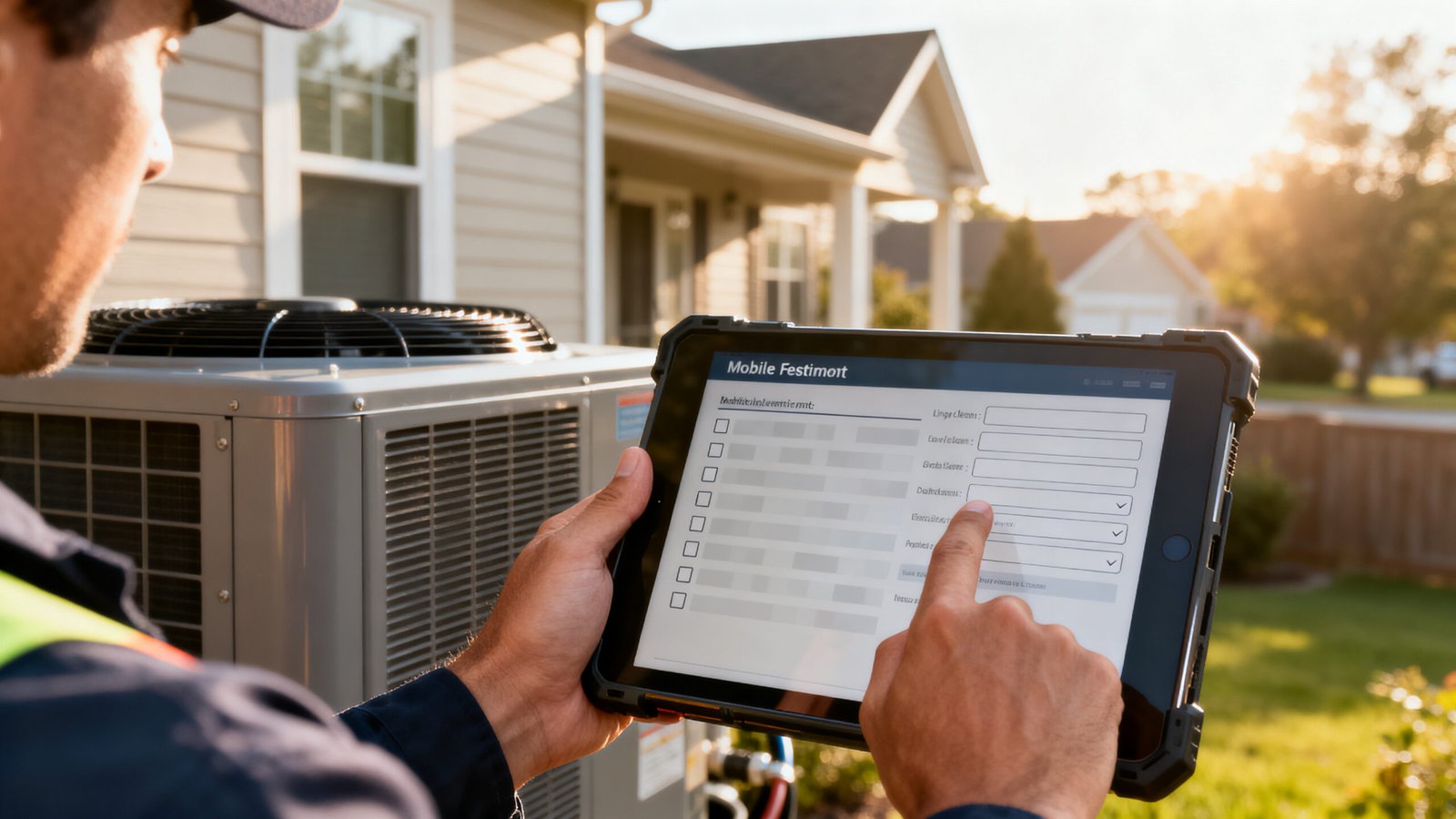
Customers expect to see equipment and parts, labor and installation, ductwork, permits and inspections, disposal and removal, and add ons all itemized separately. When these categories appear as preloaded placeholders, techs are far less likely to skip one under time pressure. Using a professional estimate template with these fields already built saves mental bandwidth on every call.
Recommended Pricing Breakdown Guidance
No contractor survey exists that states exact customer expected percentages for parts versus labor versus refrigerant versus markup. What exists is homeowner insistence on transparency and clear category separation. Here is how to present pricing in a way that looks justified without overcomplicating the math.
Based on a 2026 HVAC installation cost guide, a typical central air system with SEER2 compliant equipment shows equipment costs of approximately $3,200 to $5,800 and labor and install costs of $2,000 to $4,500, for a total range of $5,200 to $10,300. This implies equipment is roughly 55% to 62% of the total and labor is roughly 38% to 45% in these examples.
Illustrative sample breakdown for an HVAC bid template (not regulatory guidance):
| Category | Amount | Percent of Total |
|---|---|---|
| Equipment (condenser, air handler, coil, thermostat) | $4,200 | 58% |
| Labor and installation (2 crew, 8 hours) | $2,600 | 36% |
| Permits and disposal | $450 | 6% |
| Total job price | $7,250 | 100% |
Contractor training commonly teaches targeting a 40% to 50% gross margin by dividing direct cost by roughly 0.6. The remaining portion covers overhead and profit. This is not something you need to show customers directly, but it informs how you set your numbers. The key presentation principle is that the estimate looks complete and the math makes sense at a glance. A PDF estimate generator that auto calculates subtotals and percentages removes manual math errors that erode trust.
Refrigerant in full system replacements is typically a small single digit percentage of the total job and is often embedded in equipment or startup materials. For major repairs or recharges, however, list refrigerant type and quantity as a separate visible line item due to phase out related price volatility.
Mandatory Regulatory and Disclosure Fields
There is no single federal rule titled “HVAC estimate disclosure law.” Requirements come from EPA and DOE rules, FTC energy labeling rules, state contractor licensing laws, and utility rebate program requirements. Here is what every 2026 residential HVAC replacement estimate should include as a minimum.
- Model numbers and efficiency ratings: SEER2, HSPF2, and AFUE values must be accurately stated. Misrepresenting these on quotes or advertising can trigger compliance issues. Many state energy efficiency programs require documented proof of rated efficiency to qualify jobs for rebates.
- Refrigerant type: Identify the refrigerant used, such as R410A or R32. EPA’s AIM Act is phasing down HFCs, and including this on the estimate demonstrates regulatory awareness and reduces misrepresentation risk.
- Contractor license number: Most states require license numbers on contracts and estimates, especially for jobs above a threshold that often falls between $500 and $1,000. Verify your state’s specific requirement.
- Incentive labeling: If you mention rebates or tax credits, label them correctly. The 25C federal program is a tax credit, not a point of sale discount. HEEHRA is a rebate. Include eligibility conditions such as income limits and qualifying equipment criteria. Never guarantee an incentive the customer may not qualify for.
- State specific disclosures: Right to cancel periods for door to door sales, deposit limits, and progress payment caps vary by state. Include these on the estimate or contract as required by your jurisdiction.
The safest approach is to preload all mandatory disclosure fields into your free HVAC estimate template so they cannot be forgotten in the field. Verify state specific contract and disclosure laws with local counsel. Do not promise rebates or tax credits as guaranteed.
The Checklist of Commonly Forgotten Fees
Hidden fees are the number one source of post contract disputes in residential HVAC. When a cost hits the homeowner’s invoice that was never mentioned on the air conditioning estimate form or the heating estimate template, trust evaporates instantly. Here are the categories most frequently omitted, based on homeowner complaint analysis and contractor guidance.
| Forgotten Fee Category | How to Handle in Template | Risk if Omitted |
|---|---|---|
| Permit and inspection fees | Preload as mandatory line item with local default cost | Customer sees surprise charge as deceptive |
| Removal and disposal of old equipment | Always include; specify refrigerant recovery compliance | Post install haul away fee damages reviews |
| Electrical upgrades and corrections | Conditional line item with $0 default but visible | Panel or disconnect upgrades become “hidden cost” complaints |
| Duct modifications, sealing, and balancing | Add inspection checkbox; preload sealing as recommended add on | Comfort and noise complaints after install |
| Condensate pumps and drain line work | Include in scope notes with conditional pricing | Code violations and water damage liability |
| Minor carpentry, patching, and structural | Preload as separate line with “if needed” estimate range | Customer disputes over cosmetic outcomes |
| Additional accessories and startup materials | Thermostat, surge protector, pad, vibration isolators | Small add ons feel like nickel and diming |

Preloading these categories as visible line items, even with a $0 placeholder, eliminates the “you never told me about this” conversation. It also demonstrates thoroughness during the sales process. A customer who sees a contractor thinking through electrical, ductwork, and condensate management on the initial estimate is a customer who stops calling other bidders.
Design and Presentation Formats
No verifiable HVAC specific behavioral data exists comparing completion rates or approval rates by template format type. No platform publishes anonymized statistics showing whether mobile forms outperform PDFs or Excel sheets. The best practice recommendation is to offer multiple formats so contractors can choose what fits their workflow.
Three formats to provide with the free HVAC estimate template:
- Mobile fillable form: Best for onsite quoting. Tech fills fields on a phone or tablet, attaches photos, and sends for e signature before leaving the driveway. This is the fastest format for seasonal demand spikes when speed to proposal matters.
- Branded PDF: Best for professional presentation and follow up. A branded estimate PDF looks polished in email and prints cleanly for kitchen table reviews. Homeowners often print estimates to compare, and a well designed PDF stands out.
- Excel or CSV export: Best for internal estimating and job costing. Allows office managers to import line items into accounting software, track material costs, and maintain historical pricing data for future bids.
Since format performance data is not available, the safe strategy is to provide all three formats so contractors can choose the workflow that saves them the reported 15 to 45 minutes per quote from vendor case studies.
Time Savings and Sales Impact
Be honest about what the evidence supports. No HVAC specific, peer reviewed study quantifies exactly how many minutes a preloaded template saves or precisely how much close rates improve. However, field service platform vendors and internal case studies provide directional figures that are reasonable to cite with appropriate caveats.
Moving from manual or Excel based quotes to digital templates has been reported in trade industry marketing to reduce quote creation time from roughly 30 to 60 minutes down to 5 to 15 minutes per job. That represents a reduction of roughly 15 to 45 minutes per HVAC service quote. Software vendors in home services sometimes claim 10% to 20% relative increases in close rates after adopting digital proposals, but these figures are vendor reported and not independently verified for the HVAC niche specifically.
What you can reasonably tell a skeptical owner is this: “Vendor case studies suggest we can shave 15 to 45 minutes off each quote and see modest close rate improvements. Even if the real number is half that, the time savings alone pay for the template software in the first week of peak season.” That is a supportable, conservative claim.
How to Use the Downloadable Template
Here is a short standard operating procedure that turns the free HVAC estimate template into a reliable closing workflow. Adapt the steps to your company’s specific tools and team structure.
- Pre visit intake: Office collects homeowner’s current system details, home square footage, comfort complaints, and budget range before the tech arrives. Load this into the job record so the tech walks in prepared.
- Onsite measurements: Tech performs a Manual J load calculation or uses a validated sizing method. Attach the load calc summary to the estimate. Homeowners have rejected bids that did not provide sizing justification. Do not skip this step.
- Fill the mobile form: Tech selects equipment from a preloaded catalog, checks conditional line items, adds notes and photos directly in the form. Every mandatory field is filled before the form can be finalized.
- Generate branded PDF: Include the load calc summary, equipment photos, rebate summary, and an e signature link. Send it to the homeowner before leaving the property or within the hour.
- Follow up email: Send a short email with the PDF attached, a brief summary of the recommended system, and a link to schedule a call or accept the proposal. Include a phone script for the follow up call that references specific line items from the estimate.
Best practice guidance recommends including load calculation summary and efficiency documentation on quotes. Homeowners have rejected bids that did not provide sizing justification. Making this part of your standard template workflow removes that objection permanently.
Template Language Samples
Copy and paste these neutral framing snippets directly into your HVAC bid template. Adjust for your state’s specific requirements and your company’s voice.
Scope of work intro: “This estimate covers the complete replacement of the existing central air conditioning system at [address]. Work includes removal and legal disposal of existing equipment, installation of all new equipment listed below, system start up and commissioning, and a final walkthrough with the homeowner.”
Conditional language for hidden items: “Electrical work assumes existing breaker and wiring are adequate for new equipment specifications. If code required upgrades are identified during installation, a separate change order will be provided for approval before additional work begins. Ductwork pricing assumes existing ducts are in serviceable condition. Any required modifications, sealing, or replacement runs discovered during installation will be quoted separately.”
Rebate and tax credit disclaimer: “Federal 25C tax credit availability is estimated based on equipment specifications as of the date of this estimate. This is a tax credit, not a point of sale discount. Eligibility depends on your individual tax situation. HEEHRA rebates are income qualified and subject to state program availability. Consult your tax professional. Contractor makes no guarantee of incentive qualification.”
Warranty and license disclosure: “Manufacturer warranty terms are provided by the equipment manufacturer and are subject to their terms and conditions. Labor warranty covers installation related defects for the period stated. [Company Name] is licensed by the [State Board], license number [XXX]. This estimate is valid for [X] days from the date above.”
Research advises that if incentives are mentioned, they must be accurately labeled as tax credits or rebates and eligibility conditions must be noted. Many states require license and contact information on contracts and estimates.
Metrics to Track and ROI
No public dataset quantifies how much top HVAC firms budget specifically for quote presentation or the exact correlation with ticket size. Treat presentation tools and template software as part of sales overhead and measure return on investment through the following key performance indicators.
Track these metrics before and after adopting the template:
- Time per quote: Measure from arrival onsite to estimate sent. Baseline it now so you can quantify the reduction.
- Close rate: Track proposals sent versus contracts signed. A directional improvement of even 5% to 10% on high ticket jobs is significant revenue.
- Percentage of jobs with change orders: The goal is to drive this down. Fewer change orders mean fewer disputes and higher margins.
- Average ticket: Monitor whether itemized transparency encourages homeowners to choose higher efficiency or accessory packages.
- Follow up contact attempts: If customers respond faster to professional estimates, this number should drop.
Give the template at least a full season of consistent use before drawing conclusions. Seasonal demand fluctuations and equipment availability swings can mask real improvements in a short sample window.
Downloadables and Next Steps
To make this free HVAC estimate template immediately useful, the following deliverables should be embedded or linked in this post for download. Because format performance data is not available, provide all three formats so contractors can choose the workflow that fits their business.
- Fillable mobile form: A Google Form or web app based template for onsite quoting with required field validation.
- Branded PDF template: A printable HVAC quote template PDF with your company logo, color scheme, and all line item fields preloaded.
- Excel or CSV estimating sheet: For internal job costing and historical pricing tracking.
- Quick SOP checklist: The five step workflow from this post condensed into a one page printable checklist for techs.
- Sample email and phone scripts: Ready to customize follow up templates that reference specific estimate line items.
- Sample load calc summary snapshot: An example of what to attach to estimates to demonstrate proper sizing.
Download the templates, customize the branding and default fields for your market, train your techs on the workflow once, and then measure the KPIs listed above over the next season.
Conclusion
A free HVAC estimate template does more than save time. It changes how homeowners perceive your company before they ever see the final price. When every line item is accounted for, every efficiency rating is documented, and every potential hidden cost is addressed with a visible placeholder, the homeowner’s hesitation dissolves. They stop shopping. They sign.
The template in this guide addresses the three most common reasons bids fail: lack of detailed scope, missing design justification, and unclear net cost after incentives. It includes the mandatory disclosure fields, the commonly forgotten fee categories, and the language samples that reduce legal risk and change order disputes. Download the formats that fit your workflow, implement the SOP, and start tracking your close rate. The time to upgrade your estimates is before the next seasonal demand spike hits.
Frequently Asked Questions
What should a professional HVAC estimate include?
A professional HVAC estimate should include equipment model numbers and efficiency ratings, labor and installation hours, ductwork modifications if applicable, permit and inspection fees, disposal of old equipment, electrical work, accessories, startup and commissioning details, warranty terms, taxes, and payment terms. Homeowner guides consistently recommend demanding this level of detail and treating vague lump sum bids as inferior.
Why do homeowners reject lump sum HVAC bids?
Homeowners reject lump sum bids because they cannot compare them, cannot verify proper sizing or equipment quality, and perceive the contractor as less professional. Consumer education resources like Angi explicitly advise homeowners to favor detailed itemized estimates and walk away from contractors who refuse to provide a breakdown. Vague quotes signal risk to the buyer.
How much time can a digital estimate template save per quote?
Field service vendor case studies suggest moving from manual or Excel quotes to digital templates can reduce quote creation time from 30 to 60 minutes down to 5 to 15 minutes, a savings of roughly 15 to 45 minutes per quote. These figures are vendor reported and not independently verified for the HVAC niche specifically, but they provide a reasonable directional estimate.
Are there legal disclosure requirements for HVAC estimates in 2026?
There is no single federal HVAC estimate disclosure law. Requirements come from EPA and DOE efficiency rules, FTC energy labeling rules, state contractor licensing laws, and utility rebate program rules. At minimum, estimates should include model numbers, SEER2 or HSPF2 or AFUE ratings, refrigerant type, contractor license number, accurate incentive labeling, and any state mandated consumer protection disclosures.
What hidden fees do HVAC contractors most often forget to include?
The most commonly forgotten fee categories are permit and inspection fees, removal and disposal of old equipment, electrical upgrades and code corrections, duct modifications and sealing, condensate pump and drain line work, minor carpentry and patching, and additional accessories like thermostats and surge protectors. Preloading these as visible line items in the template, even at $0, prevents post install disputes.